Showing posts with label defense spending. Show all posts
Showing posts with label defense spending. Show all posts
Friday, April 23, 2021
We MUST Cut US Military Defense Spending
Seriously, America, Americans, we must, must cut defense spending. It is huge, it is bloated, it is wasteful and it actually ends up weakening the nation.
Contact your members of Congress. Tell them.


Monday, November 16, 2020
USA: It Sucks to be You?
I saw this article today.

Check that out.
Canada was recently ranked the second most beautiful country in the world, and now it is being hailed for its quality of life.
In fact, Canada took the top spot for the category in the latest 2019 Best Countries Rankings by U.S. News and World Report. What's more, this is the country's fourth year in a row in the ranking's top spot.
America? Shall we compare?
- Guess what neighbor to the North has universal health care?
- Guess what neighbor to the North didn't tie health care to profit?
- And who's people don't go bankrupt from health care costs?
- And who's number 1 cause of bankruptcy for citizens isn't health care costs?
- And also has far less guns and weapons?
- And far less shootings and killings?
- And doesn't pay out an obscene amount every year for "defense"?
- And doesn't have an idiotic, self-serving, greedy, uninformed leader of their nation?
So... Ladies and gentlemen?
Can we learn anything?
Maybe?
Could we?
Please?
Saturday, July 4, 2020
Either Instead of or Along With Defunding Police, Let's Do These
Either instead of or along with defunding police, for a much better, stronger society, let's do the following, instead. I've been saying this for years.

We pay more out, year after year, than any other country, far and away, for what we call "defense." We buy bombs and weapons and have bases all over the world.
You'd think we were still fighting World War II.
And we just keep increasing how much we shell out for this "defense."
It's insane. It's not rational. It's certainly not moral nor necessary. It's not making us stronger, either, as a nation. This businessman said this correctly and it was 3 years ago.
And keep this in perspective, too, before anyone says it would weaken us as a nation.
If we cut our defense budget in half---cut it IN HALF---we'd still, still outspend and overspend EVERY OTHER NATION IN THE WORLD. Still.
Then, after that, how about we STOP INCARCERATING SO MANY AMERICANS.
Check this out.
We incarcerate more people THAN ANY OTHER NATION.
Put that into perspective.
China has approximately 1.43 billion citizens.
India, 1.353 billion people.
We, the US?
We have a paltry 329 million people.
But we jail more fellow Americans than ANY OTHER NATION, to repeat.
How is this not insane? It's completely, totally unnecessary. Again, obscene and immoral.
Here's a thought.
Instead of jailing so many people, how about we take that money and, oh, I don't know. INVEST IN THEIR SCHOOLS, instead?? Invest in health care? Invest in social programs? Take care of our people instead of throwing them away?
Check out this one statistic:
America Spends Much More on Prisoners
Than Students
The U.S. spends more on prisons and jails than it does on educating children – and 15 states spend at least $27,000 more per prisoner than they do per student, according to a new report. (link below)
And along with this incarceration is the fact that, since the end of the Civil War, we, the United States, have also disproportionately incarcerated FAR more African-Americans as a percentage of our population.
Black Americans incarcerated five times more
than white
Let's stop this insanity. Let's stop this ugliness. Let's stop this waste and stupidity.
Let's do this, America.
Let's invest in our people.
We'll be far stronger, all of us, because of it.
Sunday, September 15, 2019
The Singular Most Important Article Any Adult American Could Read Today
There is a fantastic, long, long overdue article in today's Sunday New York Times that says everything I and a lot of us have ever thought about present day America, our defense spending and our insane, inane perpetual, endless war.

The Only Way to End ‘Endless War’
First, America has to give up its pursuit of global dominance
Dr. Stephen Wertheim
As I said, I think all Americans should read it, all of it, absolutely but herewith, I'll post just a few of the most important quotes and clips. I'll begin with a stunner from none other than Republican Party President Donald J "the John" Trump.
“Great nations do not fight endless wars.”
But vowing to end America’s interminable military adventures doesn’t make it so. Four years ago, President Barack Obama denounced “the idea of endless war” even as he announced that ground troops would remain in Afghanistan. In his last year in office, the United States dropped an estimated 26,172 bombs on seven countries.
President Trump, despite criticizing Middle East wars, has intensified existing interventions and threatened to start new ones. He has abetted the Saudi-led war in Yemen, in defiance of Congress. He has put America perpetually on the brink with Iran. And he has lavished billions extra on a Pentagon that already outspends the world’s seven next largest militaries combined.
Dominance, assumed to ensure peace, in fact guarantees war.
In theory, armed supremacy could foster peace. Facing overwhelming force, who would dare to defy American wishes? That was the hope of Pentagon planners in 1992; they reacted to the collapse of America’s Cold War adversary not by pulling back but by pursuing even greater military pre-eminence. But the quarter-century that followed showed the opposite to prevail in practice. Freed from one big enemy, the United States found many smaller enemies: It has launched far more military interventions since the Cold War than during the “twilight struggle” itself. Of all its interventions since 1946, roughly 80 percent have taken place after 1991.
Why have interventions proliferated as challengers have shrunk? The basic cause is America’s infatuation with military force. Its political class imagines that force will advance any aim, limiting debate to what that aim should be. Continued gains by the Taliban, 18 years after the United States initially toppled it, suggest a different principle: The profligate deployment of force creates new and unnecessary objectives more than it realizes existing and worthy ones.
In the Middle East, endless war began when the United States first stationed troops permanently in the region after winning the Persian Gulf war in 1991. A circular logic took hold. The United States created its own dependence on allies that hosted and assisted American forces. It provoked states, terrorists and militias that opposed its presence. Among the results: The United States has bombed Iraq almost every year since 1991 and spent an estimated $6 trillion on post-9/11 wars....
Armed domination has become an end in itself. Which means Americans face a choice: Either they should openly espouse endless war, or they should chart a new course.
...the United States should pursue the safety and welfare of its people while respecting the rights and dignity of all. In the 21st century, finally rid of colonial empires and Cold War antagonism, America has the opportunity to practice responsible statecraft, directed toward the promotion of peace. Responsible statecraft will oppose the war-making of others, but it will make sure, first and foremost, that America is not fueling violence.
On its own initiative, the United States can proudly bring home many of its soldiers currently serving in 800 bases ringing the globe, leaving small forces to protect commercial sea lanes. It can reorient its military, prioritizing deterrence and defense over power projection. It can stop the obscenity that America sends more weapons into the world than does any other country. It can reserve armed intervention, and warlike sanctions, for purposes that are essential, legal and rare.
Shrinking the military’s footprint will deprive presidents of the temptation to answer every problem with a violent solution. It will enable genuine engagement in the world, making diplomacy more effective, not less. As the United States stops being a party to every conflict, it can start being a party to resolving conflicts...
Today a world with less American militarism is likely to have less militarism in general.
...there’s a reason no one can connect the dots from unceasing interventions to a system of law and order. After decades of unilateral actions, crowned by the aggressive invasion of Iraq, it is U.S. military power that threatens international law and order. Rules should strengthen through cooperation, not wither through imposition.
In truth, the largest obstacle to ending endless war is self-imposed. Long told that the United States is the world’s “indispensable nation,” the American people have been denied a choice and have almost stopped demanding one. A global superpower — waging endless war — is just “who we are.”
But it is for the people to decide who we are, guided by the best of what we have been. America “goes not abroad in search of monsters to destroy,” Secretary of State John Quincy Adams said in 1821. “She might become the dictatress of the world. She would be no longer the ruler of her own spirit.”
Two centuries later, in the age of Trump, endless war has come home. Cease this folly, and America can begin to take responsibility in the world and reclaim its civic peace.
Benefits to the nation, to us all, if we were to do this?
- First and foremost, it would save our military soldiers' lives..
- As the article points out so clearly, it would reduce war and terror in the world.
- Next, it would cut our spending, our obscene government spending
- We could spend far more wisely on our infratstructure--schools, bridges, roads, HEALTHCARE.
- In short, we could support and invest in our people, in the nation. Imagine better roads, smarter healthcare, better schools, no poverty, fewer, in not zero Americans on the street, impoverished, sick, etc.
- Finally, on this short list, we could also SAVE MONEY.
Any of those, let alone all, are worthy and all are possible, honestly, if we only ended this insanity of perpetual war, the path we're on now.
We have been in Aghanistan EIGHTEEN YEARS. Does anyone really think we've improved things over there? Worse, does anyone think we will (improve things there)?
Finally, here today, for anyone who says we must keep up our "defense spending" because have a "war on terror", I quote the following:
"We will bankrupt ourselves in the vain search for absolute security." --Dwight D. Eisenhower
"The catch-all phrase "the war on terrorism", in all honesty, has no more meaning than if one wants to wage a war against "criminal gangsterism". Terrorism is a tactic. You can't have a war against a tactic. It's deliberately vague and non-definable in order to justify and permit perpetual war anywhere and under any circumstance." --Ron Paul
"Always there has been some terrible evil at home or some monstrous foreign power that was going to gobble us up if we did not blindly rally behind it." --Douglas MacArthur
"Terrorism is the war of the poor, and war is the terrorism of the rich." --Peter Ustinov
And the best, most true quote on the "war on terrorism" nonsense comes, for me, from Gore Vidal:
“You can’t have a war on terrorism because that’s not an actual enemy, it’s an abstract. It’s like having a war on dandruff. That war will be eternal and pointless. It’s idiotic. That’s not a war, it’s a slogan. It’s a lie. It’s advertising, which is the only art form we ever invented in America. And we use it to sell soap, war and presidential candidates in the same fashion.”

Wednesday, August 14, 2019
All the Ways America Is "Exceptional"
That last "American Exceptionalism" post here yesterday got me thinking. In fact, I've been thinking about it for some time. So on that thought, let's have a list of some of the biggest things we're "number one" at, America.

- We pay more for health care as a percentage of GDP than any other nation
- Only nation wherein people go bankrupt for healthcare costs
- Only nation with the highest amount of bankruptcies due to healthcare costs
- More guns than any other nations, per capita
- More shootings than any other nation
- More killings, homicides than any other nation
- Spend more--far, far more--than any other nation on guns and bombs and weapons, calling it "defense." We spend 7 times more on the military than any other nation on the planet. Worse, U.S. military spending is greater than the military spending of China, Russia, Japan, India, and the rest of NATO combined
- We have more foreign military bases than any other nation; Empire much?
- We have more citizens incarcerated, in prisons, than any other nation
- We have the highest percentage of the population that is obese
- We have the highest divorce rate
- Highest rate of illegal drug use in the world
- More reported murders than any other nation
- More total crimes committed in the US than anywhere else in the world
- We have more student loan debt than any other country and finally, at least here and now,
- We have the most complicated tax system in the world
- Biggest Weapons exporter in the world
- We kill more people with drones, presently, than any other nation; Some of what our big "defense" budget gets us, I'm sure
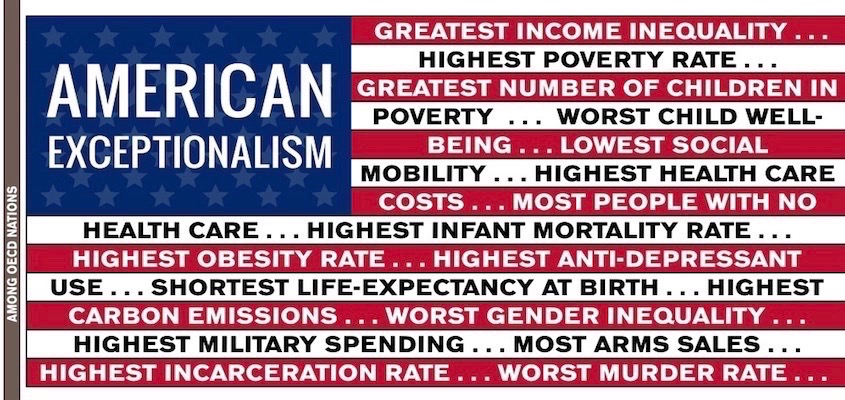
But wait. There's more. There's more of our positions in the world and these are things we're not number one at:
- The U.S. ranks 23rd in gender equality
- The U.S. ranks 33rd in internet download speeds
- The U.S. ranks 46th in freedom of the press
- The U.S. ranks 26th in child well-being
- The U.S. ranks 24th in literacy
- The U.S. ranks 19th in perceived honesty
- The U.S. ranks 27th in leisure and personal care
- The U.S. ranks 17th in happiness
- The U.S. ranks 9th in retirement security
- The U.S. ranks 99th in peacefulness
- The U.S. ranks 24th in freedom from corruption
- The U.S. ranks 16th in manufacturing compensation costs
- The U.S. ranks 29th in intellectual property protection
- The U.S. ranks 23rd in wage distribution
- The U.S. ranks 10th in purchasing power of minimum wage
- The U.S. ranks 11th in minimum wage
Let's do this.
Links:
The Myth of American Exceptionalism
Saturday, September 1, 2018
What Most Americans Don't Know About Our National Defense Budget--But Should
There is an excellent, even important article out presently at Alternet I wish all adult, voting-age Americans would read. It is this.
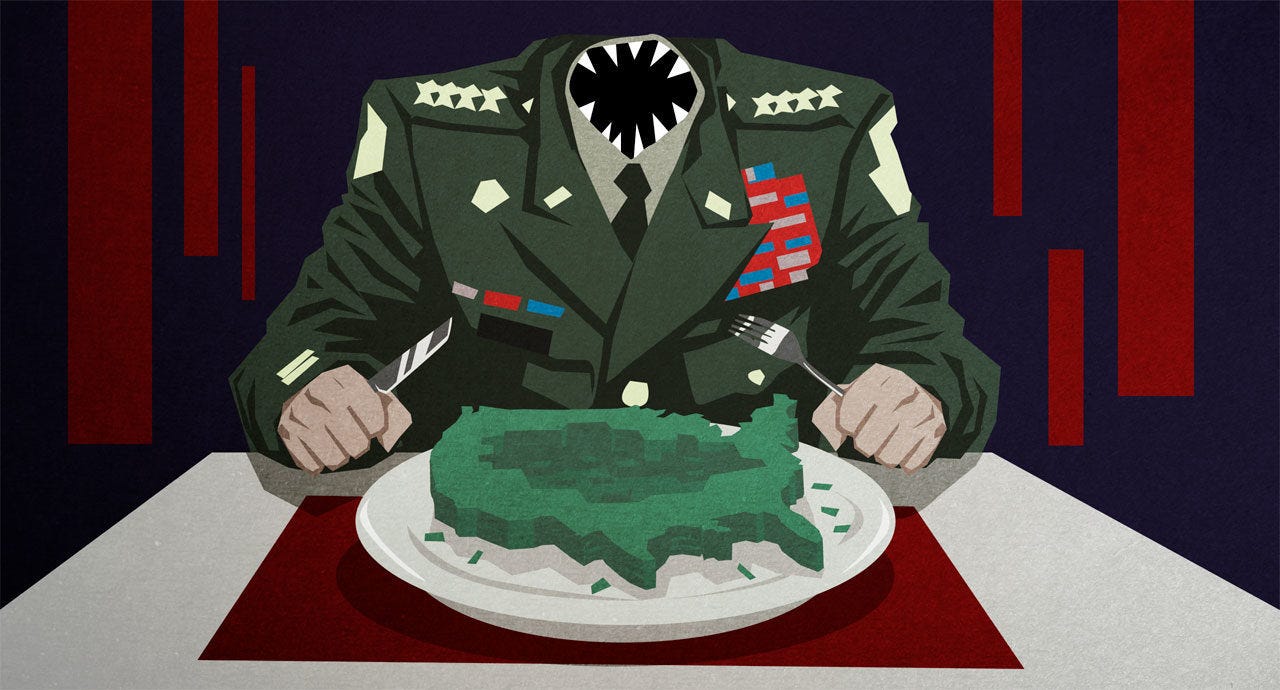
How to Blow $700 Billion and Lose Wars
A Guide to America's Exploding Defense Budget and Military Failure
Step 1: Buy the most expensive weapons in history. Step 2: Don’t use them, since they mostly don’t work
A bit from the article:
This year, President Trump signed the largest defense budget in our history: $700 billion. The budget includes $13.7 billion for 90 F-35 Joint Strike Fighters, which according to CNN are “in service and mission capable only 26 percent of the time.” Not a single F-35 jet has yet to see combat duty.
The budget will provide $4.5 billion for the construction of a new Ford class aircraft carrier, $450 million for three Littoral Combat Ships, $4 billion for two new guided missile destroyers, $5.5 billion for two new Virginia Class submarines, and tens of billions more for upgrades and repairs on various aircraft and naval vessels. Two of the guided missile destroyers already in service were involved in deadly collisions with cargo ships in the western Pacific last year. A Navy investigation revealed that for all of the hundreds of billions spent on defense, there was apparently not enough in the budget to provide for adequate training in standing watch and driving Navy combat ships...
He finishes the article perfectly, to me. It's something I've been saying for some time.
From 2011 to today, 2018, we more than doubled our national defense budget from 354 billion dollars to 700 billion.
We have no new enemies. No new group has attacked us or is attacking. Or is going to.
We are weakening, actually weakening our nation with all this absurd, obscenely expensive and very wasteful spending.
Understand this:
Our defense budget is very huge, very bloated and very wasteful and is actually making the nation weaker. Not stronger.
What are we going to do about this, America?
Links:
Note this next article is from the American Conservative magazine:
Thursday, July 5, 2018
What People Don't Understand About Our National Defense Spending
What too many people, too many Americans don't understand or realize about our obscene, absurd, very bloated and extremely wasteful defense spending.
It's actually making us weaker, as a nation.
Monday, May 28, 2018
Quote of the Day -- On Patriotism

"We Americans claim to be a peace-loving people. We hate bloodshed; we are opposed to violence. Yet we go into spasms of joy over the possibility of projecting dynamite bombs from flying machines upon helpless citizens. We are ready to hang, electrocute, or lynch anyone, who, from economic necessity, will risk his own life in the attempt upon that of some industrial magnate. Yet our hearts swell with pride at the thought that America is becoming the most powerful nation on earth, and that she will eventually plant her iron foot on the necks of all other nations.
Such is the logic of patriotism."
--Emma Goldman, "What is Patriotism?", 1908
Saturday, May 19, 2018
Quote of the Day -- On Defense--and Deficit--Spending

"For 40 years we were led to think of the Russians as godless, materialistic and an evil empire. When the Cold War ended, we suddenly discovered that Russia was a poor Third World country. They had not been equipped to take over the world. In fact, they were just trying to improve a miserable standard of oppressive living, and couldn't. They had to spend too much on arms build-up. We didn't win the Cold War; we bankrupted the Russians. In effect, it was a big bank exhausting the reserves of a smaller one."
And now, we're doing it to ourselves. That is, we are bankrupting ourselves, honestly, spending obscene amounts on "defense", far outspending any and every other nation on the planet.
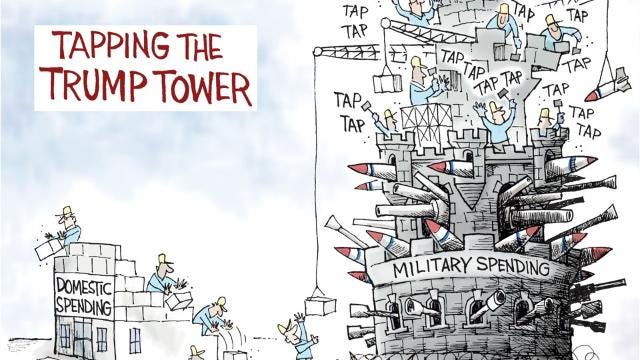
And for no good reason.
Friday, March 30, 2018
"American Exceptionalism" -- Exposed

Herewith, things we Americans do that no other Western, industrialized nation does.
First, we don't control weapons
Why the US has the most mass shootings
Second, we tie health care to profits.
Report: US Spends More Per Person On Health Care
And these are the results:
U.S. Healthcare: Most Expensive
and Worst Performing
Third, we don't take care of our people, instead, we spend outrageously, even obscenely on what we call "defense."
US military spending dwarfs rest of world
The US spends more on defence than
all of these countries combined
US Military Spending Actually Weakens
Nation's Defenses
Fourth and finally here, we, lots of us, think of ourselves, proudly, as the "wealthiest nation in the world" presently, if not ever, on the face of the planet, through time, when statistics show some pretty incredible insights to it.
Why is poverty higher in the U.S.
than in other countries?
So here's to you, America. This is how you really are and this is what you do.
Aren't you exceptional?
Isn't just enough to make you proud?
Wednesday, March 21, 2018
I Say Again, America, You Are the World's Warmonger
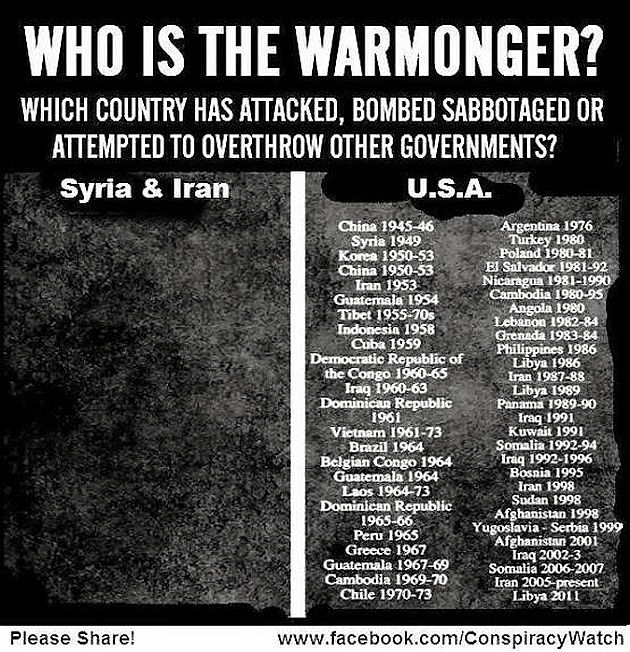
Andrew J. Bacevich pens a magnificent, wholly unsolicited letter to the editor of the New York Times, A.G. Sulzberger. He asks for some coverage our nation has needed for some time. It's a letter I wish most all adult Americans would read and be exposed to.
On Seeing America's Whole Wars:
A Memo to the Publisher of the
New York Times
New York Times
Six Questions for A.G. Sulzberger
By Andrew J. Bacevich
March 20, 2018
Dear Mr. Sulzberger:
Congratulations on assuming the reins of this nation’s -- and arguably, the world’s -- most influential publication. It’s the family business, of course, so your appointment to succeed your father doesn’t exactly qualify as a surprise. Even so, the responsibility for guiding the fortunes of a great institution must weigh heavily on you, especially when the media landscape is changing so rapidly and radically.
Undoubtedly, you’re already getting plenty of advice on how to run the paper, probably more than you want or need. Still, with your indulgence, I’d like to offer an outsider’s perspective on “the news that’s fit to print.” The famous motto of the Times insists that the paper is committed to publishing “all” such news -- an admirable aspiration even if an impossibility. In practice, what readers like me get on a daily basis is “all the news that Times editors deem worthy of print.”
Of course, within that somewhat more restrictive universe of news, not all stories are equal. Some appear on the front page above the fold. Others are consigned to page A17 on Saturday morning.
And some topics receive more attention than others. In recent years, comprehensive coverage of issues touching on diversity, sexuality, and the status of women has become a Times hallmark. When it comes to Donald Trump, "comprehensive" can’t do justice to the attention he receives. At the Times (and more than a few other media outlets), he has induced a form of mania, with his daily effusion of taunts, insults, preposterous assertions, bogus claims, and decisions made, then immediately renounced, all reported in masochistic detail. Throw in salacious revelations from Trump’s colorful past and leaks from the ongoing Mueller investigation of his campaign and our 45th president has become for the Times something akin to a Great White Whale, albeit with a comb-over and a preference for baggy suits.
In the meantime, other issues of equal or even greater importance -- I would put climate change in this category -- receive no more than sporadic or irregular coverage. And, of course, some topics simply don’t make the cut at all, like just about anything short of a school shooting that happens in that vast expanse west of the Hudson that Saul Steinberg years ago so memorably depicted for the New Yorker.
The point of this admittedly unsolicited memo is not to urge the Times to open a bureau in Terre Haute or in the rapidly melting Arctic. Nor am I implying that the paper should tone down its efforts to dismantle the hetero-normative order, empower women, and promote equality for transgender persons. Yet I do want to suggest that obsessing about this administration’s stupefying tomfoolery finds the Times overlooking one particular issue that predates and transcends the Trump Moment. That issue is the normalization of armed conflict, with your writers, editors, and editorial board having tacitly accepted that, for the United States, war has become a permanent condition.
Let me stipulate that the Times does devote an impressive number of column-inches to the myriad U.S. military activities around the planet. Stories about deployments, firefights, airstrikes, sieges, and casualties abound. Readers can count on the Times to convey the latest White House or Pentagon pronouncements about the briefly visible light at the end of some very long tunnel. And features describing the plight of veterans back from the war zone also appear with appropriate and commendable frequency.
So anyone reading the Times for a week or a month will have absorbed the essential facts of the case, including the following:
* Over 6,000 days after it began, America’s war in Afghanistan continues, with Times correspondents providing regular and regularly repetitive updates;
* In the seven-year-long civil war that has engulfed Syria, the ever-shifting cast of belligerents now includes at least 2,000 (some sources say 4,000) U.S. special operators, the rationale for their presence changing from week to week, even as plans to keep U.S. troops in Syria indefinitely take shape;
* In Iraq, now liberated from ISIS, itself a byproduct of U.S. invasion and occupation, U.S. troops are now poised to stay on, more or less as they did in West Germany in 1945 and in South Korea after 1953;
* On the Arabian Peninsula, U.S. forces have partnered with Saudi Crown Prince Mohammad Bin Salman Al Saud in brutalizing Yemen, thereby creating a vast humanitarian disaster despite the absence of discernible U.S. interests at stake;
* In the military equivalent of whacking self-sown weeds, American drones routinely attack Libyan militant groups that owe their existence to the chaos created in 2011 when the United States impulsively participated in the overthrow of Muammar Gaddafi;
* More than a quarter-century after American troops entered Somalia to feed the starving, the U.S. military mission continues, presently in the form of recurring airstrikes;
* Elsewhere in Africa, the latest theater to offer opportunities for road-testing the most recent counterterrorism techniques, the U.S. military footprint is rapidly expanding, all but devoid of congressional (or possibly any other kind of) oversight;
* From the Levant to South Asia, a flood of American-manufactured weaponry continues to flow unabated, to the delight of the military-industrial complex, but with little evidence that the arms we sell or give away are contributing to regional peace and stability;
*Amid this endless spiral of undeclared American wars and conflicts, Congress stands by passively, only rousing itself as needed to appropriate money that ensures the unimpeded continuation of all of the above;
*Meanwhile, President Trump, though assessing all of this military hyperactivity as misbegotten -- “Seven trillion dollars. What a mistake.” -- is effectively perpetuating and even ramping up the policies pioneered by his predecessors.
This conglomeration of circumstances, I submit, invites attention to several first-order questions to which the Times appears stubbornly oblivious. These questions are by no means original with me. Indeed, Mr. Sulzberger (may I call you A.G.?), if you’ve kept up with TomDispatch -- if you haven’t, you really should -- you will already have encountered several of them. Yet in the higher reaches of mainstream journalism they remain sadly neglected, with disastrous practical and moral implications.
The key point is that when it comes to recent American wars, the Times offers coverage without perspective. “All the news” is shallow and redundant. Lots of dots, few connections.
To put it another way, what’s missing is any sort of Big Picture. The Times would never depict Russian military actions in the Crimea, eastern Ukraine, and Syria, along with its cyber-provocations, as somehow unrelated to one another. Yet it devotes remarkably little energy to identifying any links between what U.S. forces today are doing in Niger and what they are doing in Afghanistan; between U.S. drone attacks that target this group of “terrorists” and those that target some other group; or, more fundamentally, between what we thought we were doing as far back as the 1980s when Washington supported Saddam Hussein and what we imagine we’re doing today in the various Muslim-majority nations in which the U.S. military is present, whether welcome or not.
Crudely put, the central question that goes not only unanswered but unasked is this: What the hell is going on? Allow me to deconstruct that in ways that might resonate with Times correspondents:
What exactly should we call the enterprise in which U.S. forces have been engaged all these years? The term that George W. Bush introduced back in 2001, “Global War on Terrorism,” fell out of favor long ago. Nothing has appeared to replace it. A project that today finds U.S. forces mired in open-ended hostilities across a broad expanse of Muslim-majority nations does, I suggest, deserve a name, even if the commander-in-chief consigns most of those countries to “shithole” status. A while back, I proposed “War for the Greater Middle East,” but that didn’t catch on. Surely, the president or perhaps one of his many generals could come up with something better, some phrase that conveys a sense of purpose, scope, stakes, or location. The paper of record should insist that whatever it is the troops out there may be doing, their exertions ought to have a descriptive name.
What is our overall objective in waging that no-name war? After 9/11, George W. Bush vowed at various times to eliminate terrorism, liberate the oppressed, spread freedom and democracy, advance the cause of women’s rights across the Islamic world, and even end evil itself. Today, such aims seem like so many fantasies. So what is it we’re trying to accomplish? What will we settle for? Without a readily identifiable objective, how will anyone know when to raise that “Mission Accomplished” banner (again) and let the troops come home?
By extension, what exactly is the strategy for bringing our no-name war to a successful conclusion? A strategy is a kind of roadmap aimed at identifying resources, defining enemies (as well as friends), and describing a sequence of steps that will lead to some approximation of victory. It should offer a vision that gets us from where we are to where we want to be. Yet when it comes to waging its no-name war, Washington today has no strategy worthy of the name. This fact should outrage the American people and embarrass the national security establishment. It should also attract the curiosity of the New York Times.
Roughly speaking, in what year, decade, or century might this war end? Even if only approximately, it would help to know -- and the American people deserve to know -- when the front page of the Times might possibly carry a headline reading “Peace Secured” or “Hostilities Ended” or even merely “It’s Over.” On the other hand, if it’s unrealistic to expect the ever-morphing, ever-spreading no-name war to end at all, then shouldn’t someone say so, allowing citizens to chew on the implications of that prospect? Who better to reveal this secret hidden in plain sight than the newspaper over which you preside?
What can we expect the no-name war to cost? Although the president’s estimate of $7 trillion may be a trifle premature, it’s not wrong. It may even end up being on the low side. What that money might otherwise have paid for -- including infrastructure, education, scientific and medical research, and possibly making amends for all the havoc wreaked by our ill-considered military endeavors -- certainly merits detailed discussion. Here’s a way to start just such a discussion: Imagine a running tally of sunk and projected cumulative costs featured on the front page of the Times every morning. Just two numbers: the first a tabulation of what the Pentagon has already spent pursuant to all U.S. military interventions, large and small, since 9/11; the second, a projection of what the final bill might look like decades from now when the last of this generation’s war vets passes on.
Finally, what are the implications of saddling future generations with this financial burden? With the sole exception of the very brief Gulf War of 1990-1991, the no-name war is the only substantial armed conflict in American history where the generation in whose name it was waged resolutely refused to pay for it -- indeed, happily accepted tax cuts when increases were very much in order. With astonishingly few exceptions, politicians endorsed this arrangement. One might think that enterprising reporters would want to investigate the various factors that foster such irresponsibility.
So that’s my take. I’m sure, A.G., that journalists in your employ could sharpen my questions and devise more of their own. But here’s a small proposition: just for a single day, confine Donald Trump to page A17 and give our no-name war the attention that the Times normally reserves for the president it loathes.
I’m not a newspaperman, but I’m reminded of that wonderful 1940 Hitchcock movie Foreign Correspondent. I expect you’ve seen it. Europe is stumbling toward war and Mr. Powers, head honcho at the fictitious New York Globe, is tired of getting the same-old same-old from the people he has on the scene. “I don't want any more economists, sages, or oracles bombinating over our cables,” he rages. “I want a reporter. Somebody who doesn't know the difference between an ism and a kangaroo.”
His rant requires deciphering. What Powers wants is someone with the combination of guts and naiveté to pose questions that more seasoned journalists trapped in a defective narrative of their own creation simply overlook.
So he pulls the decidedly unseasoned and spectacularly uninformed John Jones off the police beat, renames him Huntley Haverstock, sets him up with an expense account, and sends him off to take a fresh look at what gives in Europe. Haverstock proceeds to unearth the big truths to which his more sophisticated colleagues have become blind. Almost singlehandedly he alerts the American people to the dangers just ahead -- and he also gets the girl. Terrific movie (even if, given Hitchcock’s well-documented mistreatment of women, it may be politically incorrect to say so).
Anyway, A.G., we need you to do something approximating what Mr. Powers did, but in real life. Good luck. I'm in your corner.
Andrew J. Bacevich, a TomDispatch regular, is the author of America’s War for the Greater Middle East: A Military History and other books.
Follow TomDispatch on Twitter and join us on Facebook. Check out the newest Dispatch Book, Alfred McCoy's In the Shadows of the American Century: The Rise and Decline of U.S. Global Power, as well as John Dower's The Violent American Century: War and Terror Since World War II, John Feffer's dystopian novel Splinterlands, Nick Turse's Next Time They’ll Come to Count the Dead, and Tom Engelhardt's Shadow Government: Surveillance, Secret Wars, and a Global Security State in a Single-Superpower World.
Copyright 2018 Andrew J. Bacevich

Tuesday, February 27, 2018
The Republicans Are Shattering the Nation, Honestly
Besides the fantastic leaders the Republicans have foisted on us---think Nixon, Trump and Greitens, as just 3 quick examples--it seems we just keep getting yet more gifts from these people. This news story broke today.

The US's national debt spiked $1 trillion
in less than 6 months
So they railed against big budgets and too much spending for 8 years while a Democrat was in the White House but when they get their own man in there, what do they do? Do they slash spending and whittle down the deficit they hate so much?
Heck no!
They've done quite the opposite, as we keep seeing! First it was with their budget giveaway for the already-wealthy and corporations.
Not done there, they also did their best to increase other spending and unnecessary, at that.
Then look what they've done to "Obamacare" and health care in the nation, folks.
The stupidity of Trumpcare: Government will spend $33 billion more to cover 8.9 million fewer Americans, as premiums soar
They wanted to make sure they undid President Obama's legacy on health care, for sure. So we'll all be paying more for health insurance, fewer will have coverage and so, access to health care and then the nation will spend more to get it all.
Fantastic, no?
Finally, here are just two of the results of their tax plan.
They famously, even infamously did it in and to Kansas, as we all watched, right next door, from 2012 to today with Governor Brownback's and the Republican Party's tax cuts for the already-wealthy and corporations.
Did anyone learn?
Oh, heck no. So here we go again. Some more. But on a larger, national scale now.
God help them if they go after Medicare, Medicaid, Social Security and other budgets.
For the love of God and all that's good, someone, someone tell me why anyone but the wealthy votes Republican.
Subscribe to:
Posts (Atom)

 Posts
Posts




