

TOKYO – The government set its first radiation safety standards for fish Tuesday after Japan's tsunami-ravaged nuclear plant reported radioactive contamination in nearby seawater measuring at several million times the legal limit.
Showing posts with label Pacific Ocean. Show all posts
Showing posts with label Pacific Ocean. Show all posts
Saturday, August 4, 2018
With All This Plastic In Our Oceans...
I keep seeing, day after day, video on all the plastic in our oceans and on sea life, choking, killing them. Maybe you've seen some of them.
So with all this, is anyone asking what the cruise ships are doing with their waste from onboard?
Are they still dumping? Indiscriminately?
Shouldn't there be laws, international laws, all making this illegal?
Can we not all agree on that?
Saturday, February 10, 2018
The Only Way We'll Stop Polluting the Planet
I've worked at a couple huge, national corporations and noticed a continuing, repeated thread running through them.
Corporations and all the employees that work for them throw away and waste a great deal of plastics and papers and cardboard and aluminum cans and glass.
Corporations, with all those people, create and then throw away all these materials.
And they do it daily. Weekly. Month after month. Year after year.
And they have no desire nor motivation to reduce the amount of waste and wastes and what ends up as pollution, landfill. It's what gets us these results:
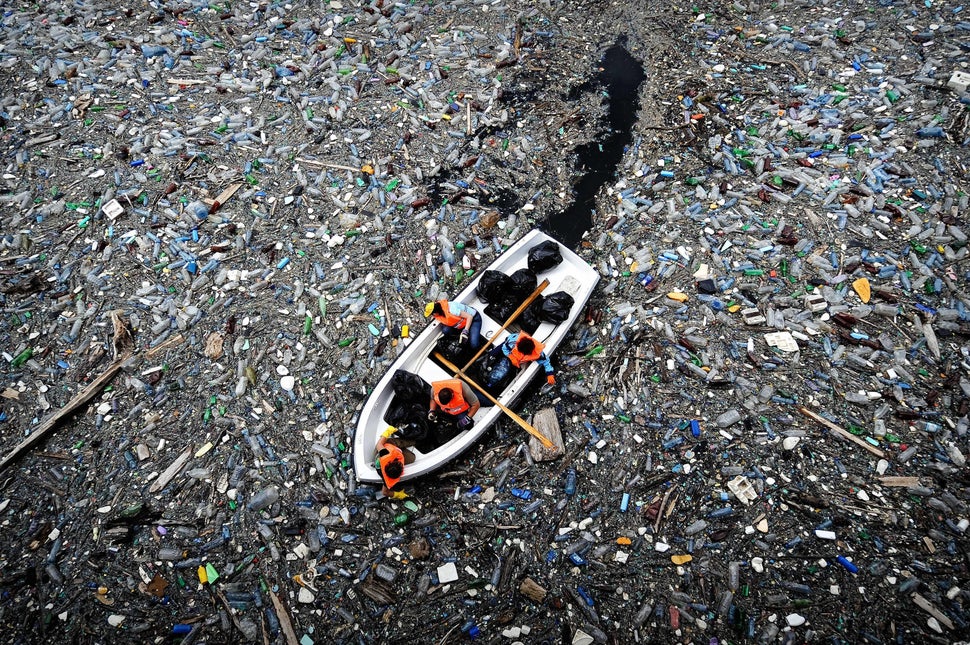
Plastic Garbage Patch Bigger
Than Mexico Found in Pacific
'Plastic in All Sizes' Found Everywhere
in Once Pristine European Arctic
Nasa animation shows how ‘garbage islands’ have taken over the seas in the last 35 years
Corporations are all about profit and profits, of course. Because of that, they're also about cutting costs. They're about cutting costs at all costs. Recycling requires commitment. It requires spending. Those are costs they don't want to assume or commit to.
So let's face it. The only way we, as a nation and planet, can get them to start recycling and at least reduce, if not end polluting will be for government and governments, state by state and nation by nation, to require them to do so, to start and keep recycling.
Think about the waste.
Think about how much paper and plastic alone each McDonald's restaurant throws out. Daily. Then think of the entire company.
AT&T
GE
Alcoa
Dupont
Bayer
The list goes on. Company after company. All over the nation, continent and world.
We must do this. We must require this. We have to call them out on this. They won't do it on their own.
An upside to all this, besides that we'll clean up our planet is that it will also create jobs. Those are two huge wins for humanity and the planet.
The thing is, it must come from us, from the people.
Links:
And it's not just the oceans, of course.
Tuesday, July 30, 2013
The way we live isn't sustainable

Don't believe in man-mad global warming and climate change, fine.
But know this, as said above, the way humankind lives on this planet isn't sustainable, not remotely.
We need to change. We have to change. We have to change we live on and effect this planet. We have to stop pouring garbage and dirt into the air, water and soil.
Monday, April 2, 2012
Finally: News about the radiation on the US from Fukushima
Ever since the Fukushima nuclear plant in Japan blew, I've wondered how much radiation hit the US. And since then, I've seen nothing, nothing about it from media or our government. That surprised me a bit--I'm very naive about far too much--and disappointed me. Finally, today, an article on the internets: California Slammed With Fukushima Radiation "The Journal Environmental Science and Technology reports in a new study that the Fukushima radiation plume contacted North America at California 'with greatest exposure in central and southern California', and that Southern California's seaweed tested over 500% higher for radioactive iodine-131 than anywhere else in the U.S. and Canada:
Projected paths of the radioactive atmospheric plume emanating from the Fukushima reactors, best described as airborne particles or aerosols for 131I, 137Cs, and 35S, and subsequent atmospheric monitoring showed it coming in contact with the North American continent at California, with greatest exposure in central and southern California. Government monitoring sites in Anaheim (southern California) recorded peak airborne concentrations of 131I at 1.9 pCi m−3." As the post then so wisely and succinctly says: "Anaheim is where Disneyland is located." Just in case you're thinking no one's out there or effected.
 But wait! There's more! There's much, much more! (Naturally) In addition, radioactive debris is starting to wash up on the Pacific Coast. And because the Japanese are burning radioactive materials instead of disposing of them, radioactive rain-outs will continue for some time … even on the Pacific Coast. Nice, huh? So what are our respective governments doing about it, if anything, you might ask? Your answers: Instead of doing much to try to protect their citizens from Fukushima, Japan, the U.S. and the EU all just raised the radiation levels they deem “safe”.
 Nuclear expert Arnie Gundersen says that high-level friends in the State Department told him that Hillary Clinton signed a pact with her counterpart in Japan agreeing that the U.S. will continue buying seafood from Japan, despite that food not being tested for radioactive materials.
 And the Department of Energy is trying to replace the scientifically accepted model of the dangers of low dose radiation based on voodoo science. Specifically, DOE’s Lawrence Berkeley Labs used a mutant line of human cells in a petri dish which was able to repair damage from low doses of radiation, and extrapolated to the unsupported conclusion that everyone is immune to low doses of radiation… Isn't that all just lovely? So, finally, what is our government's response to information and data going foward? Great question: American and Canadian authorities have virtually stopped monitoring airborne radiation, and are not testing fish for radiation. If you weren't sick before, you probably should be now. (If after all that, you really are nauseous--not surprisingly--the comments at the links below have some magnificent, very dry and ascerbic wit to them, if that helps).
Links: http://www.zerohedge.com/contributed/2012-13-30/california-slammed-fukushima-radiation; http://www.zerohedge.com/contributed/update-fukushima-0; http://www.zerohedge.com/contributed/fukushima-radiation-highest-ever-exceeding-capacity-measuring-device-fuel-likely-leaking;
http://www.zerohedge.com/article/no-amount-radiation-released-japanese-nuclear-reactors-not-safe; http://www.zerohedge.com/contributed/radioactive-iodine-blankets-much-europe-everyone-points-fingers


Thursday, January 5, 2012
Tuesday, April 5, 2011
The latest from Japan's reactor
Out today:
Japan sets new radiation safety level for seafood
And I would hope they would, yes, but it wasn't necessary until now, when water from the Fukushima nuclear reactor started pouring out.
Details:
The plant operator insisted that the radiation will rapidly disperse and that it poses no immediate danger...
Naturally.
...but an expert said exposure to the highly concentrated levels near the Fukushima Dai-ichi plant could cause immediate injury and that the leaks could result in residual contamination of the sea in the area.
But here's the real catch, here's what we need to know and watch:
Experts agree that radiation dissipates quickly in the vast Pacific, but direct exposure to the most contaminated water measured would lead to "immediate injury," said Yoichi Enokida, a professor of materials science at Nagoya University's graduate school of engineering.
He added that seawater may be diluting the iodine, which decays quickly, but the leak also contains long-lasting cesium-137, which can build up in fish over time. Both can build up in fish, though iodine's short half-life means it does not stay there for very long. The long-term effects of cesium, however, will need to be studied, he said.
I think what needs to happen now, and I hope it happens both for scientists learning and education and our own safety, I would hope this radioactive water will be followed somehow, if it's possible, off the coast of Japan, to see if the radioactivity stays there or just how far it does, in fact, travel.
Unfortunate but fascinating stuff.
Monday, April 4, 2011
The latest from Japan: radioactive desperation
News from Japan today:
Search for radiation leak turns desperate in Japan
By MARI YAMAGUCHI and YURI KAGEYAMA, Associated Press
The plant operators......deliberately dumped 10,000 tons of tainted water — measuring about 500 times above the legal limit for radiactivity — into the ocean Monday to make space at a storage site for water that is even more highly radiactive.
That's the bad news.
The REALLY bad news is that the other water, they're more concerned about and want to keep out of the ocean "contains radioactive iodine at rates 10,000 times the legal limit."
So, as usual, following the same pattern I've pointed out here a few times, first the declaration of bad news, above, followed shortly by the "all is well" call from officials. From later in the article.
Radioactivity is quickly diluted in the ocean, and Edano said the dump should not affect the safety of seafood in the area.
I ask you, if you were in or visiting Japan soon, would YOU order sushi?
At the bottom of the article (see link below), was this in tiny print: Radiation 1,600 times higher than normal levels was detected about 12 miles from the plant, the limit of the evacuation area. Radiation at that level, while not high for a single burst, could harm health if sustained.
Makes me feel better already.
Link: http://news.yahoo.com/s/ap/as_japan_earthquake
Thursday, March 31, 2011
Japan's latest daily shocker
It's Thursday so it must be yet another overnight revelation from Japan:
Radioactivity 10,000 times standard at Japan plant
Okay, so, get ready. First there's the shocking revelation of the day:
TOKYO – Officials with the company that operates Japan's tsunami-stricken nuclear plant say radioactive contamination in groundwater underneath a reactor has been measured at 10,000 times the government health standard.
Then there's the sure-to-be-given reassurance from the government and nuclear officials:
A spokesman for plant operator Tokyo Electric Power Co. says the company doesn't believe any drinking water supply is affected
If you go to this article (link below), you'll see the updated article seems to have quite additional alarm, too. It seems the Japanese have now put out a plea to the world nations, asking for all the help they can get.
Yikes.
Anyway, check out this quote from a Japanese official:
"U.S. nuclear plants aren't by the ocean, unlike Japanese ones, so we think the French may be able to help us more than the Americans," said TEPCO Manager Teruaki Kobayashi.
Excuse me? Ever heard of San Onofre? As in California? On the Pacific Ocean?
And Diablo Canyon? Also in California? Ever heard of those?
And then there's the Salem reactor in Salem, Delaware incidentally right next to the Hope Creek Nuclear Generating Station (link below) but,yeah, other than those...
And then there's the Salem reactor in Salem, Delaware incidentally right next to the Hope Creek Nuclear Generating Station (link below) but,yeah, other than those...
Anyway, for the poor Japanese people it seems things are quite desperate and getting worse. Hopefully the bad news and additional revelations end soon--as soon as possible and as positively as possible, given all they've been through and what they're still going through.
Links: http://news.yahoo.com/s/ap/as_japan_earthquake; http://www.exeloncorp.com/powerplants/oystercreek/Pages/profile.aspx; http://www.sfgate.com/cgi-bin/article.cgi?f=/c/a/2011/03/31/MNT31IMGTS.DTL; http://en.wikipedia.org/wiki/Diablo_Canyon_Power_Plant; http://www.sfgate.com/cgi-bin/article.cgi?f=/c/a/2011/03/31/MNT31IMGTS.DTL; http://www.silive.com/news/index.ssf/2011/03/nj_nuclear_power_plant_less_th.html; http://en.wikipedia.org/wiki/Salem_Nuclear_Power_Plant
Wednesday, March 30, 2011
On Japan's nuclear meltdown: Here we go again
Indeed, here we go again.
First there's this:
First there's this:
On Wednesday, nuclear safety officials said seawater 300 yards (meters) outside the plant contained 3,355 times the legal limit for the amount of radioactive iodine — the highest rate yet and a sign that more contaminated water was making its way into the ocean.
Then, predictably, there's this:
The amount of iodine-131 found south of the plant does not pose an immediate threat to human health but was a "concern," said Hidehiko Nishiyama, a Nuclear and Industrial Safety Agency official. He said there was no fishing in the area.
These reports seem to follow this pattern virtually daily and the pattern is this: first there's news of some new, significant report, telling of surprising radioactive exposure somewhere in or around the area and then, not surprisingly, there's some nuclear or government "official" there to say, just as quickly, that everything is a-okay and, like here, that it "does not pose and immediate threat to human health...", trailing off.
Right.
Now, about that ocean front property I'd like to show you in Nevada.
Monday, March 28, 2011
More (radioactive) nonsense from Japan
How many times are we going to hear from "Japanese officials" that "everything's fine" over there and that the radioactivity "while high, is still within safe and acceptable limits for exposure to radioactivity"? I don't know if we'll be able to count that far.
The latest this morning:
The latest this morning:
Radiation in Japan seawater, soil may be spreading
Terrific, eh? Into the ocean. Yay. It just keeps getting better and better.
At the same time all the "authorities" are saying everything's still okay, there was this, from this same article:
At the same time all the "authorities" are saying everything's still okay, there was this, from this same article:
Contaminated water inside Unit 2 has tested at radiation levels some 100,000 times normal amounts, plant operator Tokyo Electric Power Co. said.
Workers also discovered radioactive water in the deep trenches outside three units, with the airborne radiation levels outside Unit 2 exceeding 1,000 millisieverts per hour — more than four times the amount that the government considers safe for workers, TEPCO said Monday.
But wait! There's more!:
New readings show contamination in the ocean has spread about a mile (1.6 kilometers) farther north of the nuclear site than before. Radioactive iodine-131 was discovered just offshore from Unit 5 and Unit 6 at a level 1,150 times higher than normal, Hidehiko Nishiyama, a spokesman for the Nuclear and Industrial Safety Agency, told reporters.
Not finished there, there's also this: "TEPCO officials said Sunday that radiation in leaking water in Unit 2 was 10 million times above normal..."
Nice, huh?
Adding to the Japanese troubles was another 6.5 earthquake
off the battered coast of Miyagi prefecture in the northeast.
Those poor people.
Meanwhile, from the "authorities" here in the States who have said we "have nothing to be concerned about regarding radiation coming over here, there's this from the Boston Globe (the one in MASSACHUSETTS. yeah, THAT one, on the EAST COAST of the US):
Elevated radiation found in rainwater
Low levels of radioactive iodine linked to the nuclear disaster in Japan were detected in a sample of rainwater in Massachusetts, state health officials announced yesterday.
I'm not suggesting we--any of us--freak out about this or that anyone panic or over-react and I understand they need to keep the populations calm but I'm just saying this whole mess isn't done and it's bigger than anyone seems to be have reported or is reporting.
Nuclear power, for the long range, especially compared to clean, renewable energy sources, has far too many additional costs, like these, above, for us to pursue it any further.
Nuclear power should now be considered--officially--"old technology" that didn't pan out.
Try to have a great week, y'all.
Friday, August 6, 2010
Forget about reducing our defense spending
I've written here before about how much we--the US--spends on defense and our military and how ridiculously high it is and how it's bankrupting us. I held out hope that we could reduce that amount. There was even that one post I had, written by a military officer, telling of both why and how we could and should reduce our defense spending. Great stuff, that one.
But now, word out today shows that China has a new missile that could be problematic for us:
Chinese missile could shift Pacific power balance
U.S. naval planners are scrambling to deal with what analysts say is a game-changing weapon being developed by China — an unprecedented carrier-killing missile called the Dong Feng 21D that could be launched from land with enough accuracy to penetrate the defenses of even the most advanced moving aircraft carrier at a distance of more than 1,500 kilometers (900 miles).
With this development, unless it turned out to be false--which I doubt seriously will happen--no president will be able to propose that we cut defense spending, even if it could be logically, statistically proven that we'd still be safe.
It seems we are doomed to spend ourselves into oblivion and debt, just as the Russians did, leading to their collapse.
I'm not suggesting this will happen any time soon but that's not to say it can't or won't eventually happen, in a decade or two. Heaven knows we're good at spending.
Side note: I want to also mention that this article I've linked to, above, is loaded, I believe, with new and important information about the defense of our carrier ships and our place in the world. It's a good and important read and I didn't/couldn't cover all the issues it raises here. It's worth the quick read.
Have a great weekend, y'all.
Wednesday, June 9, 2010
Ten Things You Should Know About Hurricane Season
With the beginning of hurricane season and because a)there has been a prediction of an active season and b) we're concerned about the oil in the Gulf of Mexico right now and through the end of the year (by Sarah Nelson):
1. Hurricane season takes up nearly half the year. Typically it last from June 1 through the end of November. Approximately 97 percent of all hurricanes occur during the official hurricane season.
2. Across the country, 12 percent of Americans live in hurricane-prone regions.
3. Hurricanes are categorized by their wind force and storm surge (the height of water pushed ashore). The weakest hurricane has winds ranging anywhere from 74 to 95 miles an hour. A category five hurricane has winds of more than 155 miles per hour. Major hurricanes are ranked as either category three, four or five storms.
4. Experts anticipate an active 2010 hurricane season. Current estimates predict 14 to 23 named storms, and three to seven major hurricanes. The annual average is 11 named stormed with six hurricanes – two of which are major.
5. The year 2005 was the most active hurricane season in recorded history with 28 named storms. Including Katrina, 2005 had 15 hurricanes, seven of which were major. Prior to that year, the most active season on record was 1933 which had a total of 21 storms.
6. The longest category five hurricane was Hurricane Allen in 1980. The storm lasted 12 days and moved from the coast of Africa all the way to Northern Mexico before dissipating into a tropical depression.
7. Hurricane evacuation orders are serious business. If local authorities evacuate a region, following instructions can be a matter of life and death. Ninety percent of hurricane-related deaths are caused by storm surge, not winds.
8. When a hurricane causes severe damage to region, a request is often made to retire that hurricane’s name. Retirement means the name cannot be used for at least ten years after the storm. In 2005, five hurricane names were retired – the most names ever retired in a single year.
9. Most hurricanes occur in the Atlantic Ocean and Gulf of Mexico, and less frequently in the Eastern Pacific Ocean. Major storms that cross between the Atlantic and Pacific oceans are renamed. Only nine storms have ever crossed oceans. The most recent major hurricane to cross oceans was Atlantic Hurricane Cesar, which became Northeast Pacific Hurricane Douglas, in 1996.
10. The frequency of tropical cyclones (a term that includes hurricanes and typhoons) over the last 35 years. Whether or not global climate change is driving the increased frequency and intensity of hurricanes and other stories remains a topic under debate – much like the ongoing and highly politicized struggle over climate change science itself.
Link to original post:
http://www.causecast.org/news_items/9842-ten-things-you-should-know-about-hurricane-season?utm_source=feedburner&utm_medium=feed&utm_campaign=Feed%3A+causecast%2Flatest_news+%28Causecast+-+Latest+News%29
Subscribe to:
Posts (Atom)

 Posts




