Blog Catalog

Showing posts with label American budget deficit. Show all posts

Friday, July 22, 2016

Question for the Republican Party


How on Earth do you have a presidential candidate, on the last night of your big, once every four years political convention, go on for over an hour, promising the sun and the moon and the stars and balanced budgets and a wall between us and Mexico and equality to the LGBTQ community (who saw that coming?) and who knows what else and then, at the very end, once he's finally, finally finished, how is it you play "Can't Always Get What You Want" by the Rolling Stones?


How do you do that?

Was that code for "Suckers! You're no way getting all I just promised you!"?

What the heck was that?

It's not even the first time this was a thing for The Donald.

'You can't always get what you want,' 

Stones tell Trump


It must be his way of telling the Stones, "up yours."

Hopefully.

That or he just told the American public that all he just promised was nonsense.

Not that that wouldn't make some twisted, Trump-sense.


Thursday, August 15, 2013

Saturday, August 3, 2013

How long with these wars, America?


The cost of war:

6714 - Number of Enduring Freedom, Operation Iraqi Freedom and Operation New Dawn casualties as confirmed by U.S. Central Command.

7 more dead this week:


- Army Sgt. Stefan M. Smith, July 23, 2013 - 24, of Glennville, Ga


- Army 1st Lt. Jonam Russell, July 23, 2013 - 25, of Cornville, Ariz


- Army Spc. Rob L. Nichols, July 23, 2013 - 24, of Colorado Springs, Colo


- Army Spc. Caryn E. Nouv, July 27, 2013 - 29, of Newport News, Va


- Army Sgt. Eric T. Lawson, July 27, 2013 - 30, of Stockbridge, Ga


- Army Sgt. Stephen M. New, July 28, 2013 - 29, of Bartlett, Tenn


- Army Spc. Nicholas B. Burley, July 30, 2013 - 22, of Red Bluff, Calif.


 Another week and another $2 Billion spent in Afghanistan. 

Total bill to U.S. Taxpayers = $1,461,095,349,726.


You want to "support the troops"?

Bring them home.  Demand that we bring them home.

You want to cut our wasteful--grossly wasteful, obscene--deficit spending?

Cut the Department of Defense budget by half.

We would still outspend the rest of the world several times over.

Wednesday, February 8, 2012

Oh, pardon me--about that budget deficit?

From Fox "News", last evening: Budget deficit shrinks to $349 billion in last four months The U.S. budget deficit registered at $349 billion for the last four months, marking a $70 billion decline from the same period a year ago, according to the Congressional Budget Office. Huh. First much higher employment numbers last week and now this. Maybe that guy in the White House isn't so stupid after all. Link: http://www.foxnews.com/politics/2012/02/07/budget-deficit-shrinks-to-34-billion-in-last-four-months/

Wednesday, November 16, 2011

On taxes and fairness

"'Do you think the millionaire ought to pay more in taxes than the bus driver,' he demands, 'or less?' The year was 1985. The president was Ronald Wilson Reagan." --Tim Dickinson writing in Rolling Stone Magazine Link: http://www.rollingstone.com/politics/news/how-the-gop-became-the-party-of-the-rich-20111109#ixzz1dudveKcZ

Friday, October 14, 2011

An education on our economy

Telling it like it is, with statistics and hard data. Frankly, we need Robert Reich and economist Paul Krugman in every presidential administration between now and when they pass, in my opinion. Then, we need to throw all the Goldman Sachs employees and former-employees out of our government.

Wednesday, September 7, 2011

China: This is why we spend so much on defense?

China is famous--notorious, infamous, really--for polluting their air, water and soil across most of the entire country. Then, they suppress their people's speech and movements and who knows what all. Poverty is still rampant across the huge nation, etc. Now? What's in the news? There's this article: Top of Chinese wealthy's wish list? To leave China BEIJING (AP) — Chinese millionaire Su builds skyscrapers in Beijing and is one of the people powering China's economy on its path to becoming the world's biggest. He sits at the top of a country — economy booming, influence spreading, military swelling — widely expected to dominate the 21st century. Yet the property developer shares something surprising with many newly rich in China: he's looking forward to the day he can leave. Su's reasons: He wants to protect his assets, he has to watch what he says in China and wants a second child, something against the law for many Chinese. Despite more economic freedom, the communist government has kept its tight grip on many other aspects of daily life. China's leaders punish, sometimes harshly, public dissent and any perceived challenges to their power, and censor what can be read online and in print. Authoritarian rule, meanwhile, has proved ineffective in addressing long standing problems of pollution, contaminated food and a creaking health care system. "In China, nothing belongs to you. Like buying a house. You buy it but it will belong to the country 70 years later," said Su, lamenting the government's land leasing system. "But abroad, if you buy a house, it belongs to you forever," he said. "Both businessmen and government officials are like this. They worry about the security of their assets." So why do I bring this up? This is the country we're supposed to be afraid of so we keep spending 700 billion dollars per year on "defense"--read: the "military-industrial complex"--but we don't otherwise have enough to pay our bills, educate our citizens and give them good health care and roads and sewer systems and other important infrastructure. It's insane. We have to stop spending so much on defense. It's unnecessary and it's ignorant. There's a lot more in the article, too, you may want to see, spelling out their many problems. Find it here: http://news.yahoo.com/top-chinese-wealthys-wish-list-leave-china-065826880.html

Wednesday, August 24, 2011

Big Oil: Big profits and tax cuts from us, to boot

How much is enough? The top five oil companies in the country raked in $70 billion--that's billion--in profits the first HALF of this year. These are some of the most profitable companies in the nation and so, the world. But here's a dirty little secret they don't want us to emphasize--they get tax subsidies. Here's another not-so-secret secret--the Republicans and Right Wingers have been fighting in the last few months to have these same wealthy companies KEEP those tax subsidies--tax breaks. "Big Oil" is sqealing like a stuck pig, too, over the mere POSSIBILITY that they might lose $400 million in subsidies. It's time to stand up, folks. It's time we speak out. This is insanity. We're being gouged at the pump and then giving them tax breaks, to boot. Sound sensible to you? Links: http://www.huffingtonpost.com/2011/07/29/big-oil-profits_n_913452.html; http://consumerist.com/2011/04/big-oil-companies-sucked-up-much-higher-profits-than-they-did-a-year-ago.html; http://thinkprogress.org/romm/2011/04/28/207983/big-oil-profits/

Friday, July 8, 2011

Hell to pay for Republican leaders in Washington

If there isn't a budget agreement in Washington from Congress and we don't raise the debt limit and nationally default on our debt, let's be clear here, it will have been the Republican leadership's fault in Washington and theirs alone. I don't think it will happen but if it does, all damage to the country, the nation's economy and the world economies will lie at their feet, singularly and solely. Link: http://www.nytimes.com/2011/07/05/us/05deficit.html

Thursday, May 19, 2011

Quote of the day

"...the federal government is basically an insurance company with an army..."  --Paul Krugman, Nobel Prize-winning Economist, author, Columnist for The New York Times

Link to original post:   http://www.commondreams.org/view/2011/05/16-2

Thursday, April 14, 2011

100 patriotic millionaires---for decency and doing what's right

From Main Street/Working America blog:

An open letter signed by more than 100 “Patriotic Millionaires”—people who care more about the direction of the country than they do about getting yet another tax break:

We are writing to urge you to put our country ahead of politics.
For the fiscal health of our nation and the well-being of our fellow citizens, we ask that you increase taxes on incomes over $1,000,000.
We make this request as loyal citizens who now or in the past earned an income of $1,000,000 per year or more.
Our country faces a choice – we can pay our debts and build for the future, or we can shirk our financial responsibilities and cripple our nation’s potential.
Our country has been good to us. It provided a foundation through which we could succeed. Now, we want to do our part to keep that foundation strong so that others can succeed as we have.
Please do the right thing for our country. Raise our taxes.


One of the Patriotic Millionaires explains her reasoning:


“For me to be sitting and hoarding my money is insane,” said Gottlieb, whose producer credits include Dirty Dancing and who now teaches at NYU’s Tisch school. “We all give to charity, but that’s not the same as creating a more equitable society.”
Gottlieb said she has been upset by the experience of her grandchildren, who attend a New York City public school where arts education has been cut and parents have had to organize an auction to try to fill the gaps. She added that raising taxes on the wealthiest people would be an important way of reducing the deficit.
“For rich people to moan and groan — nobody likes to pay increased taxes — but it’s not going to change your life in any important way,” she said. “What it can do is help your country.”

Even if you’re not a millionaire yourself, you can sign on as a supporter.


It's enough to give you hope, isn't it?


In spite of George W. Bush and his hundreds of billions of dollars in tax cuts he and the Republicans gave to the wealthiest of the country and in spite of now House Representative Paul Ryan's goal, in his budget, of giving yet more tax cuts to and for the wealthy, these people see what's right and want to follow through with it.


Maybe it will, one day, get through to the Rethugs yet.


I'm not holding my breath.

Link:  http://www.workingamerica.org/blog/2011/04/14/patriotic-millionaires-want-to-pay-more-taxes/

On corporate tax dodgers (read: cheats)

From Alternet and Rainforest Action Network (RAN):

...12 of the dirtiest corporate tax dodgers: Bank of America, Citi, JPMorgan, Wells Fargo, Chevron, BP, Shell, Exxon, Massey Energy, Alpha Natural Resources, Peabody Energy and Arch Coal. These 12 banks, oil and coal companies are largely responsible for foreclosing on millions of people’s homes and polluting our air, water and climate. At the same time, we found that they pay next to nothing into a tax system that provides the very services that protect the homeless, the sick and our environment.   


Our new infographic, Dirty Corporate Tax Dodgers, shows that banks, oil and coal companies made billions in profits last year and paid much less than their fair share in taxes. In fact, we found that if these 12 banks, oil and coal companies actually paid the IRS corporate tax rate of 35% they would be giving back $62 billion this tax season. That is almost double the $38 billion in federal budget cuts. 
To add insult to injury, while these multi-billion dollar industries we raking in the profits and evading their taxes they were also paying millions in CEO compensation and lobby dollars. These corporations are happy to pay large sums to manipulate our democracy but aren’t so interested in paying to support it.   
We were shocked to find that:
  • Chevron, Exxon, BP and Shell together made $1.26 trillion in gross revenues, but paid a paltry 2.04% average tax rate;
  • Bank of America, Citi, JPMorgan and Wells Fargo collectively dished out $83.4 million in CEO compensation;  and, while the top 4 banks made $454.4 billion in gross revenue, the top 4 oil companies made $1.26 trillion (yes that’s a ‘t'), and the top coal corporations made $17 billion, they collectively only paid $8.74 billion in federal taxes.
...let’s get one thing straight. America is not broke, and these dirty corporations don’t need any more handouts, bailouts, or subsidies. We don’t have a money problem we have a priorities problem. We’re slashing billions from our budget, much of which will come out of social services and environmental protections, while allowing corporate giants to slip ever-increasing profits into offshore accounts.  
By reversing years of tax giveaways to the largest corporations, Congress could raise trillions in revenue not only covering our budget deficit but also enhancing education, health and environmental programs that safeguard our families and our future. 
Like the now old saying goes, "If you're not angry, you're not paying attention."

Thursday, March 24, 2011

"YOU CAN'T HANDLE THE TRUTH!"

Remember that now-old movie line from Tom Cruise's character?

Well, it applies to too many of us Americans when it comes to our national budget deficit spending.

To wit:

Think and assume that Republicans are the ones who are good at cutting budgets and deficit spending?

Think again:

"Dwight Eisenhower was last Republican President to preside over a balanced budget. He had a balanced budget in 1956 and 1957.
Since then, there have been two presidents to preside over balanced budgets, LBJ in 1969 and Clinton in 1998 through 2001.
During the last 40 years there have been five budget surpluses, all five were under Democratic Presidents: 1969, 1998, 1999, 2000, and 2001.
As we joked when we were kids at home:  "Hurts, don' it?"

Saturday, March 19, 2011

GOP House? You're not saving taxpayers money with this NPR thing anyway

That House vote on NPR funding I've been writing about?  Turns out the Rethugs haven't thought it all out.


At all.


From Think Progress blog:


Rep. Justin Amash (R-MI) noted on Fox "News" that the bill voted on earlier this week would not save a dime of taxpayer money:

The federal government does not subsidize NPR directly. Instead, the government funds the Corporation for Public Broadcasting, a government entity, which has discretion to provide funding to whichever private radio producers it chooses. H R 1076 does not actually save taxpayer dollars; it merely blocks CPB from exercising its discretion to send funding to NPR. The funds CPB does not send to NPR under the bill are returned to CPB to be spent subsidizing other private radio producers. I offered an amendment in the Rules Committee to require that any funds not sent to NPR be redirected to pay down the deficit, but the amendment was ruled out of order. Therefore, public broadcasting will not see any reduction in federal funding even if this bill becomes law.

"...as Amash and many Democrats have correctly pointed out, the bill doesn’t actually save taxpayer money — it merely moves around money already allocated to the Corporation for Public Broadcasting, away from NPR and to other public broadcasting operations. Amash also wrote that the bill is 'arguably unconstitutional and definitely violates the Rule of Law,' because 'it likely is a bill of attainder.'”

I would only find the Republican leadership in Washington funny if they weren't also so danged evil.

And selfish.

And greedy.

And too frequently effective, in spite of themselves.

Have a great weekend, ya'll.

Link to original post:   http://thinkprogress.org/2011/03/18/gop-rep-npr-defunding-does-not-save-money/

Wednesday, March 2, 2011

Don't like our deficit spending?

It seems the Tea Party in particular, but Republicans, too, want to complain--and loudly, repeatedly--about the nation's deficit spending, ever since this (black) president came into office.  Forget that the last (white) president spent us into a ditch and the worst economic situation in the last 80 years, since the 30's and the Great Depression.  You didn't hear complaining then.

Check out this chart, below.  Look at this graph.  Click on it and make it larger so you can see how insanely we spend on defense (read:  guns, bombs, warplanes, warships, etc.).  

Then consider and realize what an absurd waste it is and how we could be a) spending far less and b) having a far better quality of life in this country, if we'd stop giving all this money over to defense contractors and the "military-industrial complex" and their lobbyists in Washington.

Next up:  Health care spending in the US vs. the world.

Monday, February 21, 2011

The Wealthy, The Republicans and Power in America

Besides the power play that's being fought in Wisconsin right now that I posted on earlier, the other power play that's also being fought right now in Washington and across the country, is the Republican leaders' attempts to take all money away from the Corporation for Public Broadcasting and so, NPR (formerly National Public Radio) and PBS (formerly the Public Broadcasting System).

And the reasoning and examples proving it are easy and obvious.

One of the most obvious "burrs" in the side of Corporate America and so, their underlings, the Republican leadership, used to be Bill Moyers, his writing and his TV shows, specifically "Bill Moyers Journal" that used to run on PBS.

That program routinely exposed both Corporate America's worst transgressions, but also government's, so the American people knew what we were up against and possibly, likely what we had to work for and be aware of.

Friday evening, I saw another PBS program, this one ProPublica's Abraham Lustgarden on Congress's Fracking Report.

First, a quick definition:  Fracking is an abbreviation for hydraulic fracturing, which energy companies have created and use for getting more oil and gas out of the ground.  It "is a process that results in the creation of fractures in rocks. The most important industrial use is in stimulating oil and gas wells, where hydraulic fracturing has been used for over 60 years in more than one million wells.  The fracturing is done from a wellbore drilled into reservoir rock formations to increase the rate and ultimate recovery of oil and natural gas."

The fracturing forces water and chemicals into the ground, in order to force out the oil or gas. 

The problem lies in that there are chemicals used in the process and a) they seem to be making large groups of us Americans sick who live within proximity of these wells and b) the corporations won't disclose what these chemicals are to the government and the American people.  They've already bought off enough government legislators, so far, so they don't have to report what's in the process.  In the meantime, as I said, it seems to be making whole groups of Americans sick.

So you see, it is this kind of reporting, given to us by and through PBS, that, as but one easy, current example, the oil industry, with all their millions of dollars, don't want the people of America to be aware of.  You can see how and why it would be in the energy companies' interests to then give campaign contribution money---read:  bribes---to their Congressmen to shut off the spigot of information that comes to us via the CPB. 

It's also why these same energy companies pay for advertising like I've seen recently, telling us how safe and wonderful this fracking is, so we can get energy from here in the US.  Naturally, in the ads, they don't call it fracking.  They use much gentler, far more acceptable terms.

But back to my point.

First, I believe, it was Bill Moyers and his show "Bill Moyers' Journal" that no doubt rankled Corporate America. 

Now it is the PBS show "Need to Know" which replaced Mr. Moyers.

With knowledge for the American people, too frequently comes action, particularly in really egregious cases of misplacement of trust or misuse of power and/ or money and the CPB, PBS and NPR are, at times, good sources of information for us, the American people.

Corporate America wants nothing of that, clearly.

And Corporate America will do all they can to see to it that is shut down, if possible. 

Fortunately for them but unfortunately for us, it is far too easy--and cheap--to do since all they have to do is give campaign contributions (read, again:  bribes)  to their government representatives.  Then they get whatever legislation they, the corporations, want.  We see it time and again.

It got so bad here in Missouri, on a more local level, that the Republican leaders did away with ALL campaign contribution limits, of course.  It's open season on legislators and legislation for them now, until we get that changed back. 

And the only way that will change, either in Jefferson City for our local politics or Washington, D.C. and the national level, is for the American people to demand the changes, unequivocally.

We have to care.  And work on it.

I say again:  We need true, stringent, tough and verifiable campaign finance reform in this country.  It's way overdue.

We also need legally-required campaign seasons that are only 3 to 6 months long, at most, like the British require, so we can, again, get the big money out of our campaigns.

It's in these ways we can be more sure of getting our government back working for us, the American people, instead of virtually exclusively for the wealthy and Corporate America.

Links:  http://www.pbs.org/wnet/need-to-know/video/video-propublicas-abrahm-lustgarten-on-congresss-fracking-report/7501/
http://www.propublica.org/article/questions-for-congress-and-hollywood-about-fracking
http://www.propublica.org/series/buried-secrets-gas-drillings-environmental-threat
http://www.propublica.org/article/drilling-industry-says-diesel-use-was-legal
http://www.propublica.org/article/opponents-to-fracking-disclosure-take-big-money-from-industry
http://en.wikipedia.org/wiki/Hydraulic_fracturing
http://www.pbs.org/moyers/journal/index-flash.html
http://www.npr.org/

Thursday, February 10, 2011

Revisiting the Reagan Nightmare (guest post)

By Terrance Heath

February 4, 2011

"Now that he is safely dead, let us praise him." poet Carl Wendell Hines wrote of Martin Luther King Jr., after his assassination. Ronald Reagan has been "safely dead" for just under seven years, but the economic impact of his policies remain with us.

In a sense, it's highly appropriate that the centennial of Reagan's birth falls upon us in the midst of a economic nightmare from which it is uncertain when — or if — the nation will awaken. Though we will be inevitably awash in conservative praise and hagiography of Reagan, his 100th birthday is also an occasion to remember how America's long economic nightmare began.

It's a story told many times, but it bears telling again, and again, as David Johnson did last year when he explained how the "Reagan Revolution" came home to roost. He even told it in charts.

The Reagan Revolution

View more presentations from our future.  As Dave said in his post,. take a look at a chart of almost anything, and you'll notice that right around 1981 things take a sharp turn in the wrong direction — that is, for just about everyone but the wealthiest 1%.

Conservative policies transformed the United States from the largest creditor nation to the largest debtor nation in just a few years.

And it started with Reagan. Anyone who's wringing their hands about America's debt and China's ownership of it has Reagan to thank, as Reagan's former budget director David Stockman recently explained to David Corn.

Here's how Stockman tells the tale. In the '80s, Reagan and his White House crew were eager to cut income taxes across the board. The aim, he asserts, was to fix the slumping economy, not to starve the beast of big government. Republican leaders on the Hill were initially skeptical—they insisted that the White House pass spending cuts before Congress tackled the tax side. "The honest-to-goodness fact," Stockman says, "is that in February 1981, there wasn't close to a Republican majority for tax cuts without any accompanying or coupled spending cuts. The idea of supply-side in its purest form"—that tax cuts fuel economic growth that yields increased tax revenues—"was only embraced by a handful of junior Republicans, plus Jack Kemp."

The Reagan administration hardly minded proposing massive cuts to both taxes and spending. But then things went haywire, Stockman notes. The tax cut ballooned from $500 billion over five years to $1 trillion after lobbyists added special-interest tax breaks for various industries. And on the spending side, the Reagan administration went hog-wild throwing money at the Pentagon. The inevitable happened: The deficit ballooned.


...The new doctrine got a boost when it turned out you didn't have to match tax cuts with spending cuts: The Federal Reserve was able to sell the nation's growing debt to China and others. "It totally anesthetized the political system to the costs of deficit spending," Stockman says. "Therefore the simplistic and reckless idea that the way to stimulate the economy is to cut taxes anytime, anywhere, for any reason, became embedded [in the GOP]. It has become a religion, it has become a catechism. It's become a mindless incantation."


As Paul Krugman wrote 2009, we weren't always a nation of big debts. He went on to explain how it started with Reagan.

“This bill is the most important legislation for financial institutions in the last 50 years. It provides a long-term solution for troubled thrift institutions. ... All in all, I think we hit the jackpot.” So declared Ronald Reagan in 1982, as he signed the Garn-St. Germain Depository Institutions Act.

He was, as it happened, wrong about solving the problems of the thrifts. On the contrary, the bill turned the modest-sized troubles of savings-and-loan institutions into an utter catastrophe. But he was right about the legislation’s significance. And as for that jackpot — well, it finally came more than 25 years later, in the form of the worst economic crisis since the Great Depression.

...The S.& L. crisis has been written out of the Reagan hagiography, but the fact is that deregulation in effect gave the industry — whose deposits were federally insured — a license to gamble with taxpayers’ money, at best, or simply to loot it, at worst. By the time the government closed the books on the affair, taxpayers had lost $130 billion, back when that was a lot of money.

But there was also a longer-term effect. Reagan-era legislative changes essentially ended New Deal restrictions on mortgage lending — restrictions that, in particular, limited the ability of families to buy homes without putting a significant amount of money down.

These restrictions were put in place in the 1930s by political leaders who had just experienced a terrible financial crisis, and were trying to prevent another. But by 1980 the memory of the Depression had faded. Government, declared Reagan, is the problem, not the solution; the magic of the marketplace must be set free. And so the precautionary rules were scrapped.

Together with looser lending standards for other kinds of consumer credit, this led to a radical change in American behavior.

Revisiting the Reagan ruins earlier this week, Robert Borosage explained that Reagan's de-regulatory fervor essentially gutted consumer protections.

Deregulation gutted consumer protection, environmental protection, workplace safety and the right to organize under Reagan. It led to many scandals that made his administration one of the most corrupt in history, with a record 138 officials investigated, indicted or convicted. But the biggest change was deregulation of banking, which led to successive financial wildings and crashes that have cost taxpayers literally trillions. The first was the Savings and Loan debacle that followed on Reagan's reforms that empowered banksters to gamble with other people's money, with their losses guaranteed by the federal government.

Working people's share of the benefits from increased productivity took a sudden turn down.

In the column quoted above Krugman also wrote that the increase in public debt was dwarfed by the increase in private debt, made possible by Reagan's deregulation. "It's the gift that keeps on taking," Krugman wrote. Taking, that is, from working people.

Johnson explained in his post:

Working people's share of the benefits from increased productivity took a sudden turn down:

This resulted in intense concentration of wealth at the top.


And forced working people to spend down savings to get by.

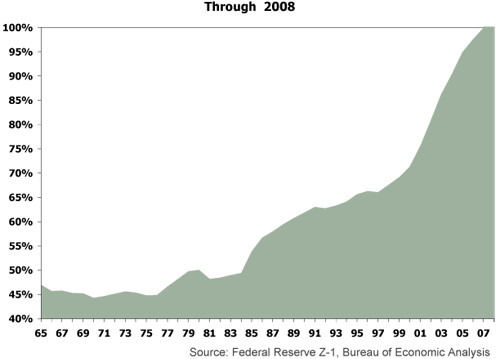
Which forced working people to go into debt: (total household debt as percentage of GDP)


But don't take my word for it, or even Johnson's. When Michael Moore contended in Capitalism: A Love Story that productivity went up during the Reagan years, while wages were frozen, Politifact (mostly) backed him up. So did the August 24, 1988 edition of the New York Times. (A couple of decades in advance.)

Not every pocketbook statistic, however, reflects so rosily on the Administration's performance. Real wages have slipped since 1980, and now are about 10 percent below the peak of 1972. Thus Mr. Bush's claim that average incomes are at a record high today only reflects the fact that more families have a second earner in the work force.

Nor is there reason to be optimistic that wage stagnation will soon end. Productivity gains, which largely determine wage increases in the long run, have slowed to a crawl in the last two decades and show little sign of revival. Moreover, America's rapidly accumulating debt to foreigners is sure to become a drag on domestic purchasing power.

Also, per Johnson's earlier instruction, notice what happens right around 1981 in this chart from a 2007 Center for Economic Policy Research report, "The Productivity to Paycheck Gap: What the Data Show," (PDF) by Dean Baker.


If workers didn't fare well under Reagan, perhaps it's because Reagan wasn't exactly a friend to working people.

Reagan's war on labor as US president began in the summer of 1981, when he fired 13,000 striking air traffic controllers and destroyed their union.

As Washington Post columnist Harold Meyerson noted in 2004, the firing was "an unambiguous signal that employers need feel little or no obligation to their workers, and employers got that message loud and clear - illegally firing workers who sought to unionize, replacing permanent employees who could collect benefits with temps who could not, shipping factories and jobs abroad."

Reagan gave dedicated union foes direct control of the federal agencies that were originally designed to protect and further the rights of workers and their unions. Most important was Reagan's appointment of three management representatives to the five- member National Labor Relations Board (NLRB).

The appointees included NLRB Chairman Donald Dotson, who declared that "unionized labor relations have been the major contributors to the decline and failure of once healthy industries" and have caused "destruction of individual freedom."

A House committee found that under Dotson, the NLRB abandoned its legal obligation to promote collective bargaining, in what amounted to "a betrayal of American workers."

As Borosage noted, that betrayal of American workers extended to "free trade" and the shipping of jobs abroad, rather than goods.


Free trade was the label affixed to a trade policy defined by and for multinational companies and banks. Under Reagan, America began shipping jobs rather than goods abroad. When Reagan fired the PATCO strikers, he signaled to corporate America that it was open season on unions. The combination was lethal for America's manufacturing base -- and for the family wage that was the signature of America's broad middle class.

As the New York Times back in 1988, not all pocketbook statistics reflected rosily on the Reagan administration's performance, but some did — and still do. At Open Left, Paul Rosenberg illustrates with a series of charts in his post "The failure of voodoo economics in pictures," what Sam Pizzigati explained in his final report card on the Reagan years.

Americans in the overall top 1 percent, the 2007 CBO data showed, did quite well in the Reagan era's first quarter-century. Their average incomes, after taking inflation into account, essentially tripled, rising 201 percent.

But these top 1 percent stats, the new CBO data help us understand, hardly tell the full story. The truly stunning income increases over recent decades have gone to the tippy-top of the U.S. income distribution, not the top 1 percent, but the top tenth — and top hundredth — of that top 1 percent.

The higher up you go on the income ladder, in other words, the sweeter the Reagan era.

Between 1979 and 2005, the bottom half of the top 1 percent saw their average incomes only double, after inflation. These incomes increased 105 percent. The next highest four-tenths of the top 1 percent somewhat raised the income bar. Their average incomes, after inflation, rose 161 percent.

That brings us to the top 0.1 percent of Americans. Their incomes, from 1979 to 2005, rose a staggering 294 percent after taking inflation into account. Not bad at all. But the top 0.01 percent did even better. The 11,000 households in this rarified air took home an average $35.5 million in 2005, a 384 percent increase over average top 0.01 percent incomes in 1979.

A lot happened after Reagan saddled up and rode off into the sunset, but nothing has yet been sufficient to rouse America or its economy from the nightmare that ensued. Even now, we live not only with the economic consequences of his "cut and spend" conservatism, but we are haunted by the narrative he established in his 1981 inaugural address: "...[G]overnment is not the solution to our problem; government is the problem."

This is the narrative that haunts us to this day; haunts us and hampers us from taking bold action to solve the problems facing America. It hampers us because it frames us as separate from government.

Government in Reagan's narrative became "the government," not "our government." The success of Reagan's narrative, all the way up to the reforms of the Obama administration and the previous Congress, have effectively scaled down our ability to address problems too large in scope to be effectively addressed by state or local governments, let alone by non-government organizations or on an individual basis.

Reagan's genius was to step into a period of uncertainty and focus the fear and anxiety of Americans on the government as the enemy. What he was really saying was "Whatever happens, you're on your own."

His self-appointed heirs are as haunted as the rest of us.

These days, no Republican with national ambitions will miss an opportunity to remind us of his or her Reaganesque bona fides. Reagan's precepts of a smaller government, a bigger military, lower taxes and conservative social policies demand absolute fealty.

The irony is that Reagan would not have become such a transformational figure if he had not challenged the political orthodoxy of his own time. His self-declared legatees invoke his name as a pledge to do the opposite, a reassurance that they will not venture beyond what has become conventional thinking in the GOP. What starts as a touchstone, however, can over time become a millstone, if history is any indication.

As a child of the 80s, who grew up during the Reagan era, I'm reminded now of Nightmare on Elm Street, a horror movie releasde in 1984, about a group of children who grew up haunted by a murderous ghost who menaced them into adulthood, until (sometime later in the series) his memory was finally banished.

As an adult, now, living amid the ruins of the Reagan era, I can only hope we will soon wake from our shared nightmare and — if not banish his memory — at least final strip it of its destructive power, reclaim our own, and allow the nightmare to fade into memory.

As do I, Terence, and more of us...

Link to original post:  http://www.ourfuture.org/blog-entry/2011020504/revisiting-reagan-nightmare