Blog Catalog

Showing posts with label WWII. Show all posts

Thursday, December 17, 2020

Quote of the Day -- Important Presidential Edition


During World War II, there was a very real and rational fear that American democracy would not survive. The danger was obvious, visceral, and violent. It was promulgated by tanks, bombs, and battleships. It was measured on maps that traced the march of armies, the swarming of navies, and the decimation of cities by aerial assault. America sat within her borders and could feel a world of madness and hatred closing in.

Since the attack came from the outside, the human inclination was to rally within one's own community for safety. That community was riven with its own violent injustices of segregation and the ugliness manifested against its citizens of Japanese ancestry. But the threat from outside was so great and would be likely so unsparing that America hardened its resolve with nearly miraculous levels of selflessness and sacrifice to the cause of survival. The cost was great in blood, particularly of the young overseas, and in treasure.

It is likely that many of you have a sense of where this is going, the comparison I seek to make.

American democracy is once again under a dire threat. Once again there is death at a scale that is incomprehensible. But the threat is of such a different nature that it may be too convenient to deny the full level of danger. This threat comes from within, a civil cleaving that instead of uniting the nation is dividing it. Perilously so.

This is not a violent threat, at least not yet despite some low-level skirmishes. That could change, but there is nothing approaching the reckoning of Nazi forces sweeping into Paris or a Japanese strike on Pearl Harbor. Meanwhile, the mass death we face doesn't lend itself to the visceral images of war. Our killer doesn't have a face or a flag. It is invisible. Instead of sending our young off to battle overseas, we have medical professionals, grocery store clerks, farmhands, and many others commuting daily into danger. We are mostly aware of what takes place within our four walls of isolation and the looming specter of hunger and homelessness for many of our fellow citizens.

But there is of course another deep worry pervasive in this country. It is about America's heretofore unbroken peaceful transfer of power between presidents. It is the notion that all of us, regardless of party, play by and revere the same democratic ideal that we the people have the power to fire our leaders in free and fair elections. This election has revealed a president who doesn't believe any of that, and a party and base that is eager to go along with him. This is not fringe; it is a movement that encompassess tens of millions of Americans. And to defeat it and preserve American democracy will require resolve, patience, ingenuity, and grit.

I believe that the nature of this threat to American democracy is not being taken nearly seriously enough. And in an odd way I find some comfort in that. I still do not believe most Americans want our ideal of representative government by majority rule to end, not by a long shot. It is tempting to laugh off the outrageousness of the court challenges and see a pathetic man desperate to hold on to fleeting power. There is truth in all of this, and I suspect Donald Trump will struggle to own the national conversation as much as he hopes once he loses his perch behind the presidential podium.

Yet the fissures laid bare by this election, and its shameful aftermath, are not going away. And every Republican official who signed their name, or even spoke by their silence, bears responsibility for what has been the most serious attempt to wreck our union internally since the Civil War. I hope, and pray, we as a nation can walk back from the ledge, that the passions can cool, and a new administration can steer our American ship of state back into the safer harbors of our democratic traditions. The struggle will not be easy, but if victory for American democracy does emerge, and I believe it will, we can resolve to make it much more secure so that this doesn't happen again.

In the dark days of World War II, it was almost impossible to imagine a bright and happy future. But that did happen. Today, we have a vaccine coming and a new government. There is danger still ahead, but hope is possible. It is a hope that must be built on hard work and action. But I would go so far as to say a realization of hope is the likely outcome. I have seen America tested many times, and usually we end up in a better place than where we started.

Steady.

--Dan Rather


Friday, May 8, 2020

Thursday, July 21, 2016

Some Relevant Missouri History


I saw this today from the New York Times. Given the presidential election currently proceeding, it's interesting to see how we've developed and changed--at least somewhat--and where our past leaders and current policies came from.

Harry S. Truman

Choosing a vice-presidential nominee has never been easy, but once upon a time the candidate at the top of the ticket didn’t have to sweat it, as it wasn’t his decision.

In the latter half of the 1800s, the power to pick a running mate often belonged to the party bosses who ran the local political machines. They helped determine turnout, which helped decide elections. Their strategy centered on geographic balance.

One of the their last great convention victories came on this day in 1944, when they replaced on the ticket President Franklin D. Roosevelt’s vice president, Henry A. Wallace, with Harry S. Truman, a Missouri senator.

Truman wasn’t the top choice of likely Democratic voters. A Gallup poll that July found that 65 percent preferred Wallace, and Truman came in eighth place, with just 2 percent.

Roosevelt didn’t want him either. The three-term president said that if he were a delegate, he would back Wallace, whom conservative party bosses opposed. Roosevelt’s wishes were ignored, and when a delegate tried to enter the vice president’s name for the nomination, the day’s proceedings were quickly adjourned.

The decision was momentous, as Roosevelt died less than three months into his fourth term and Truman ascended to the presidency. Today, it’s customary for a convention to honor the presidential nominee’s choice for vice president.


Sunday, May 8, 2016

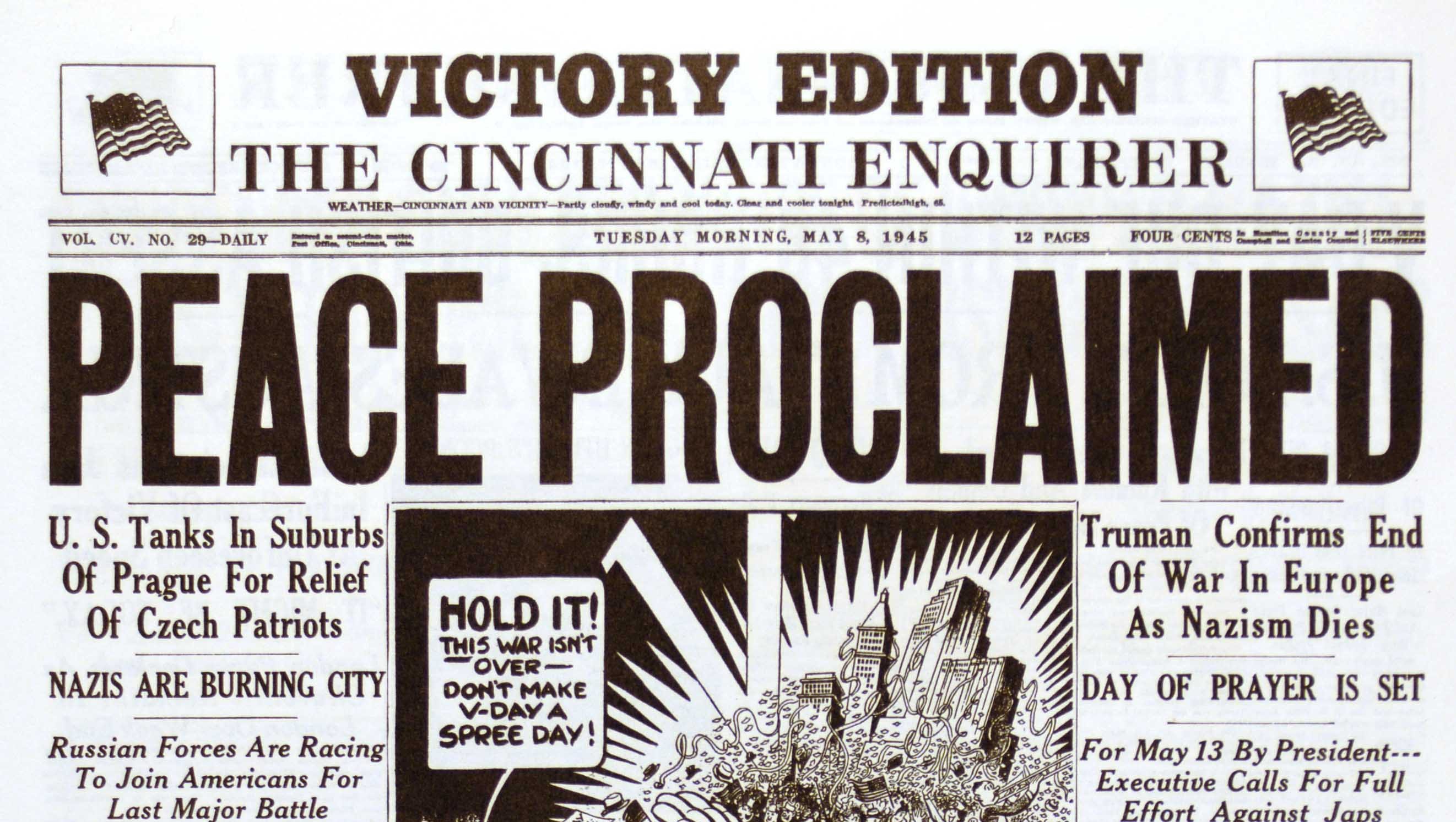
On This Day, 1945


People are forgetting.


Victory in Europe - May 08, 1945 - HISTORY.com


On this day in 1945, both Great Britain and the United States celebrate Victory in Europe Day. Cities in both nations, as well as formerly occupied cities in Western Europe, put out flags and banners, rejoicing in the defeat of the Nazi war machine. Cities in both nations, as well as formerly occupied cities in Western Europe, put out flags and banners, rejoicing in the defeat of the Nazi war machine.

Victory in Europe Day - Wikipedia


Victory in Europe Day, generally known as V-E Day, VE Day or simply V Day was the public holiday celebrated on 8 May 1945 (7 May in Commonwealth realms) to mark the formal acceptance by the Allies of World War II of Nazi Germany's unconditional surrender of its armed forces.

V-E Day 1945: The Celebration Heard 'round the World | HistoryNet


May 8, 2015 - V-E Day was observed on May 8, 1945 in Great Britain, Western Europe, the United States and Australia, and on May 9 in the Soviet Union and New Zealand. V-E Day commemorates the unconditional surrender of Nazi Germany to the Allied forces in 1945, ending World War II in Europe.


Wednesday, September 2, 2015

On This Day, September 2


For whatever reason, I thought September 2nd to be a day of significance. With that in mind, I thought I'd put together a few highlights from the date, down through the ages. Partly fun, partly educational, partly historical significance. Hopefully enjoy.

490 BC - Pheidippides, Greek hero and inspiration for the modern marathon, dies

44 BC - Queen Cleopatra VII of Egypt declares her son co-ruler as Ptolemy XV Caesarion.

- The first of Cicero's Philippics (oratorical attacks) on Mark Antony. He will make 14 of them over the next several months.

1649 - The Italian city of Castro is completely destroyed by the forces of Pope Innocent X, ending the Wars of Castro. (I love that. Pope Innocent)

1666 - Great Fire of London begins at 2am in Pudding Lane, 80% of London is destroyed

1732 - Pope Clement XII renews anti-Jewish laws of Rome. (Don'tcha' just love those oh-so-innocent Catholics?)

1864 - Union General William T. Sherman captures and burns Atlanta during US Civil War

1894 - Forest fires destroy Hinckley Minnesota: about 600 die (I can't even fathom that one)

1901 - VP Theodore Roosevelt advises "Speak softly & carry a big stick"

1902 - "A Trip To The Moon", the first science fiction film, by film great Georges Méliès released

1919 - Communist Party of America organizes in Chicago (It didn't really catch on. Not permanently, anyway)

1936 - 1st transatlantic round-trip air flight

1942 - German troops enter Stalingrad

1944 - During WW II, George H W Bush ejects from a burning plane

1944 - Holocaust diarist Anne Frank was sent to Auschwitz

1945 - Ho Chi Minh declares Vietnam independence from France (National Day) (Years later, Americans would learn nothing whatever from France's loss and exit from Vietnam and instead, attack the country)

1946 - Nehru forms government in India

1957 - US performs nuclear test at Nevada Test Site

1962 - Stan Musial's 3,516th hit moves over Tris Speaker into 2nd place

1962 - USSR performs nuclear test at Novaya Zemlya USSR

1963 - Alabama Gov George C Wallace prevents integration of Tuskegee HS

1963 - CBS & NBC expand network news from 15 to 30 minutes

1964 - Keanu Reeves birthday, Beirut, "actor"

1969 - Ralph Houk signs 3-year contract to manage Yankees at $65,000 a season (think things haven't changed a lot?)
        - The first automatic teller machine (ATM) in the United States is installed in Rockville Center, New York.

1971 - Chris Evert & Jimmy Connors win their 1st US Open tennis matches (Chris who? Jimmy who?)
         - Also his, Jimmy Connors', birthday, 1952

1972 - Rod Stewart's 1st #1 hit (You Wear it Well)

1973 - J. R. R. Tolkien, British author (The Hobbit, The Lord of the Rings)--as if you had to ask--dies of an ulcer at 81

1982 - Rolling Stone Keith Richard's house burns down

1987 - Donald Trump takes out a full page NY Times ad lambasting Japan

1997 - Howard Stern Radio Show premieres in Montreal Canada on CHOM 97.7 FM (and we still haven't gotten rid of him)

2005 - Bob Denver, American actor (Gilligan of "Gilligan's Island"), dies of complications from treatment for cancer at 70
So now, get out there, kids, and enjoy your September 2nd.

Tuesday, January 27, 2015

On this day...


The UN designated January 27—the anniversary of the liberation of Auschwitz-Birkenau—as an annual day of Holocaust remembrance. Never forget this tragedy in history so we never repeat it.

Saturday, June 7, 2014

Recommended viewing


With the 70th anniversary of the D-Day landing having been just this last week, there can be no better time than to see the still-fairly-new "Monuments Men" movie.

It's a fantastic story, beautifully shot and told and has a terrific, very full, even fun, cast to it, too. The first sight of Bill Murray is perfect, more of his tongue-in-cheek style.


This movie feels like a privilege to watch, the story is so good, so well told and so well done. I also think it tells more of the true horrors of war because, besides the war scenes, which every war movie naturally has, it shows more and better than ever before, possibly, of the horrors for the average person, the people, in this case, too, the Jews, of what exactly what they went through and the horrors. It shows, again, more personally, on the civilians' level, to the average working person, what a psychotic maniac Hitler was and the incredible damage Germany and Germans, at the time, did. It also better gives the scope of what Hitler and Hitler's Germany did.

I would go so far to say it's even an important film people need to see. It is one of those rare, terrific films you, again, feel privileged to have seen and are sorry when it ends.


Have a great weekend, y'all.


Monday, May 26, 2014

Memorial Day and the history


#ThrowbackFact: Memorial Day was started by former slaves on May, 1, 1865 in Charleston, SC to honor 257 dead Union Soldiers who had been buried in a mass grave in a Confederate prison camp. They dug up the bodies and worked for 2 weeks to give them a proper burial as gratitude for fighting for their freedom. They then held a parade of 10,000 people led by 2,800 Black children where they marched, sang and celebrated.

Thanks to Abstrakt Goldsmith for this nugget of history that most of us never learned in school and Punk Colours for sharing.


‪#‎ThrowbackFact‬: Memorial Day was started by former slaves on May, 1, 1865 in Charleston, SC to honor 257 dead Union Soldiers who had been buried in a mass grave in a Confederate prison camp. They dug up the bodies and worked for 2 weeks to give them a proper burial as gratitude for fighting for their freedom. They then held a parade of 10,000 people led by 2,800 Black children where they marched, sang and celebrated.


Thanks to Abstrakt Goldsmith for this nugget of history that most of us never learned in school and Punk Colours for sharing.


Wednesday, March 5, 2014

America: Where we were, where we are (guest post)


How many of you recall a time in America when the income of a single school teacher or baker or salesman was enough to buy a home, have two cars, and raise a family? That used to be the norm. For three decades after World War II, we created the largest middle class the world had ever seen. During those years the wages of the typical American worker doubled, just as the size of the American economy doubled. More than a third of all workers belonged to a trade union -- giving average workers the bargaining power necessary to get a large and growing share of the large and growing economic pie (now, fewer than 7 percent of private-sector workers are unionized). CEO pay then averaged about 40 times the pay of the typical worker (now it's over 300 times). 

In those years the richest 1 percent took home 9 to 10 percent of total income (today the top 1 percent gets more than 20 percent). The tax rate on highest-income Americans never fell below 70 percent; under Dwight Eisenhower, a Republican, it was 91 percent (today the top tax rate is 39.6 percent). Some of this money was used to build the largest infrastructure project in our history, the Interstate Highway system; some to build the world's largest and best system of free public education, and dramatically expand public higher education. We enacted the Civil Rights Act and Voting Rights Act to extend prosperity and participation to African-Americans; Medicare and Medicaid to reduce poverty among America's seniors; and the Environmental Protection Act to help save our planet. And we made sure banking was boring. 

Then came the great U-turn, and for the last thirty years we've been heading in the opposite direction. The collective erasure of the memory of that prior system of broad-based prosperity is the greatest propaganda victory conservatives and the privileged have ever achieved. But the fact we did it then means we can do so again -- not exactly the same way, of course, but in a new way fit for the twenty-first century and future generations of Americans. It is worth the fight.


--Robert Reich


Tuesday, January 28, 2014

Yesterday's important anniversary


Child survivors of Auschwitz, wearing adult-size prisoner jackets, stand behind a barbed wire fence. Among those pictured are Tomasz Szwarz; Alicja Gruenbaum; Solomon Rozalin; Gita Sztrauss; Wiera Sadler; Marta Wiess; Boro Eksztein; Josef Rozenwaser; Rafael Szlezinger; Gabriel Nejman; Gugiel Appelbaum; Mark Berkowitz (a twin); Pesa Balter; Rut Muszkies (later Webber); Miriam Friedman; and twins Miriam Mozes and Eva Mozes wearing knitted hats.
1945, Auschwitz, [Upper Silesia] Poland Credit: Belarusian State Archive of Documentary Film and Photography


Yesterday in 1945, the Auschwitz-Birkenau concentration camp was liberated by the Russian army. The Nazis had abandoned the camp 10 days earlier, forcing most of the prisoners into a death march that killed thousands. Those deemed too weak for the march were left behind, including these children. 

They did not know their ordeal was over until the 322nd Rifle Division of the Soviet Red Army arrived.

Since 2005, January 27th is known as International Holocaust Remembrance Day, in memory of the victims of the Holocaust, which resulted in the murder of one third of the Jewish people along with countless members of other minorities.

See the United Nations Resolution which created this Remembrance Day at http://www.yadvashem.org/yv/en/remembrance/international/pdf/un_decision.pdf

Still photograph of the children from the Soviet Film of the liberation of Auschwitz, taken by the film unit of the First Ukrainian Front, shot over a period of several months beginning on January 27, 1945 by Alexander Voronzow and others in his group. Child survivors of Auschwitz, wearing adult-size prisoner jackets, stand behind a barbed wire fence. Among those pictured are Tomasz Szwarz; Alicja Gruenbaum; Solomon Rozalin; Gita Sztrauss; Wiera Sadler; Marta Wiess; Boro Eksztein; Josef Rozenwaser; Rafael Szlezinger; Gabriel Nejman; Gugiel Appelbaum; Mark Berkowitz (a twin); Pesa Balter; Rut Muszkies (later Webber); Miriam Friedman; and twins Miriam Mozes and Eva Mozes wearing knitted hats.


Tuesday, July 2, 2013

Quote of the day--on war, from a warrior


"The world has achieved brilliance without wisdom, power without conscience.  Our is a world of nuclear giants and ethical infants.

We know more about war that we know about peace, more about killing that we know about living."

--General Omar N. Bradley

 Link:  Omar Bradley - Wikipedia


Omar Bradley Biography

Saturday, June 22, 2013

A huge, overlooked possibility of time travel


Imagine if, one day, there really were such a thing as a time machine, time travel, stepping through a "wormhole" to another time.

Imagine putting it to REALLY good use.

Imagine if the person went back and--forgive me--killed Adolf Hitler in, oh, what?  1925?


Now that's a beautiful thought.


Have a great weekend, y'all.

Edward R Murrow on America


Famed reporter, journalist and author Edward R Murrow on America and our history:


"They were ahead of the law, ahead of education and established institutions. They made their own...There grew up a tradition of violence and lawlessness... They fought a four-year civil war. And the status of the Negro...is still one of the greatest problems facing the nation. I believe we lynched only three or four of our black fellow-citizens last year, which is some improvement...

We...engineered a frontier incident with Mexico. We took that huge territory of Texas, and what is now California... Later on, we were to land marines in Nicaragua and Haiti, narrowly avoid war with Germany over Venezuela, and create a heritage of mistrust amongst the South American peoples as a result of high-handed methods and dollar diplomacy. Cuba and the Philippines came into our Lebensraum...

And all the time we were despoiling a continent. We cut the top off it, and sent the timber floating down the rivers. We ploughed the prairies, wasted our soil... Later on in this series you will hear about the New Deal, our racial problems, and how we came to be a nation of which one-third is ill-clothed, ill-housed and ill-fed. You will also hear something of our achievements."

--Edward R. Murrow from his "Meet Uncle Sam" series.  Quote taken from the book

MURROWHIS LIFE AND TIMES by A. M. Sperber


Links:   Edward RMurrow - Wikipedia

Monday, May 6, 2013

Things Americans need to know about our economy (guest post)


Things we Americans need to know, now, both about our past and current situation and what we could and should do.

From The New York Times today:

The Chutzpah Caucus

At this point the economic case for austerity — for slashing government spending even in the face of a weak economy — has collapsed. Claims that spending cuts would actually boost employment by promoting confidence have fallen apart. Claims that there is some kind of red line of debt that countries dare not cross have turned out to rest on fuzzy and to some extent just plain erroneous math. Predictions of fiscal crisis keep not coming true; predictions of disaster from harsh austerity policies have proved all too accurate. 

Yet calls for a reversal of the destructive turn toward austerity are still having a hard time getting through. Partly that reflects vested interests, for austerity policies serve the interests of wealthy creditors; partly it reflects the unwillingness of influential people to admit being wrong. But there is, I believe, a further obstacle to change: widespread, deep-seated cynicism about the ability of democratic governments, once engaged in stimulus, to change course in the future. 

So now seems like a good time to point out that this cynicism, which sounds realistic and worldly-wise, is actually sheer fantasy. Ending stimulus has never been a problem — in fact, the historical record shows that it almost always ends too soon. And in America, at least, we have a pretty good record for behaving in a fiscally responsible fashion, with one exception — namely, the fiscal irresponsibility that prevails when, and only when, hard-line conservatives are in power. 

Let’s start with the common claim that stimulus programs never go away. 

In the United States, government spending programs designed to boost the economy are in fact rare — F.D.R.’s New Deal and President Obama’s much smaller Recovery Act are the only big examples. And neither program became permanent — in fact, both were scaled back much too soon. F.D.R. cut back sharply in 1937, plunging America back into recession; the Recovery Act had its peak effect in 2010, and has since faded away, a fade that has been a major reason for our slow recovery. 

What about programs designed to aid those hurt by a depressed economy? Don’t they become permanent fixtures? Again, no. Unemployment benefits have fluctuated up and down with the business cycle, and as a percentage of G.D.P. they are barely half what they were at their recent peak. Food stamp usage is still rising, thanks to a still-terrible labor market, but historical experience suggests that it too will fall sharply if and when the economy really recovers. 

Incidentally, foreign experience follows the same pattern. You often hear Japan described as a country that has pursued never-ending fiscal stimulus. In reality, it has engaged in stop-go policies, increasing spending when the economy is weak, then pulling back at the first sign of recovery (and thereby pushing itself back into recession). 

So the whole notion of perma-stimulus is fantasy posing as hardheaded realism. Still, even if you don’t believe that stimulus is forever, Keynesian economics says not just that you should run deficits in bad times, but that you should pay down debt in good times. And it’s silly to imagine that this will happen, right? 

Wrong. The key measure you want to look at is the ratio of debt to G.D.P., which measures the government’s fiscal position better than a simple dollar number. And if you look at United States history since World War II, you find that of the 10 presidents who preceded Barack Obama, seven left office with a debt ratio lower than when they came in. Who were the three exceptions? Ronald Reagan and the two George Bushes. So debt increases that didn’t arise either from war or from extraordinary financial crisis are entirely associated with hard-line conservative governments. 

And there’s a reason for that association: U.S. conservatives have long followed a strategy of “starving the beast,” slashing taxes so as to deprive the government of the revenue it needs to pay for popular programs.
The funny thing is that right now these same hard-line conservatives declare that we must not run deficits in times of economic crisis. Why? Because, they say, politicians won’t do the right thing and pay down the debt in good times. And who are these irresponsible politicians they’re talking about? Why, themselves. 

To me, it sounds like a fiscal version of the classic definition of chutzpah — namely, killing your parents, then demanding sympathy because you’re an orphan. Here we have conservatives telling us that we must tighten our belts despite mass unemployment, because otherwise future conservatives will keep running deficits once times improve. 

Put this way, of course, it sounds silly. But it isn’t; it’s tragic. The disastrous turn toward austerity has destroyed millions of jobs and ruined many lives. And it’s time for a U-turn.

Monday, November 12, 2012

Veterans Day


The one day a year when some Americans--some--pretend to be interested and vested in the American soldiers--the men and women of the American military.

Some--a few of us--are legitimately concerned and/or involved. They usually have a family member or friend in the service.

The rest of us pretend to be interested, lots very sincerely, of course. Finally, there are the rest of Americans who pay no attention or mind to Veterans or the plight of Veterans at all.

You REALLY care about Veterans?

Push to bring them home.

Push to bring them home from Germany and Italy and Iraq and Afghanistan, once and for all.

Write your Senator. Write the President. Write your member in the House of Representatives.

Let's make peace break out.

All over.

That, ladies and gentlemen, will honor Veterans.

Monday, July 9, 2012

Is China fighting "the next war" while the US is fighting the "last war"?

For anyone who's read about or studied war, there is a famous line of thought that too many losing sides were always fighting the "last war", the previous war.

With the US still spending at least $711 million dollars per year on war and weapons of war, I think the likelihood is high that the US is still, in fact, fighting World War II or Vietnam or something, while China realizes that spending on their people and society and business and their economy is the "next war."

China is working hard and spending big on manufacturing, period, but on photovoltaic cells and solar technology, specifically, apparently and that may be, in fact, that "next war" at present.

It's fairly well accepted as truth that China is, right now, manufacturing lots of solars panels and dumping them on our American market.

The fact is, it's been widely accepted that whatever country owns solar energy in general, but photovoltaic cells, specifically, owns the next century.

Maybe we need to wise up.

And fast.

Link: http://www.globalresearch.ca/index.php?context=va&aid=31825

Sunday, June 24, 2012

Quote of the day

‎"All people of all countries want peace, only their government wants war." --Former President and military General Dwight D. Eisenhower