Blog Catalog

Showing posts with label Confederacy. Show all posts

Thursday, June 18, 2020

Missouri Senator Blunt Keeps Missouri in the Wrong and in the Past, the Racist Past


Sadly, frustratingly, we are advised today Missouri's Senator Roy Blunt plants his feet deeply in our state's and nation's racist past.

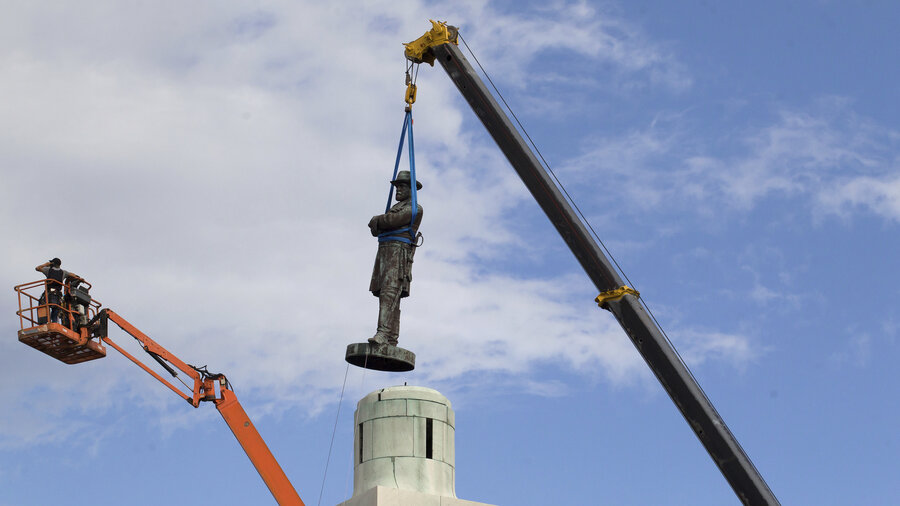
GOP senator blocks bill to remove Confederate statues from Capitol


Sen. Roy Blunt (R-Mo.) on Thursday blocked the Senate from passing a bill to remove Confederate statues from the Capitol.

Senate Minority Leader Charles Schumer (D-N.Y.) and Sen. Cory Booker (D-N.J.) tried to pass the bill by unanimous consent, which allows legislation to pass without a vote but also enables any one senator to block it.

The measure would remove statues of individuals who voluntarily served in the Confederacy from the Capitol.

Booker called keeping statues of Confederate figures in the Capitol a "painful, insulting, difficult injury."

"The continued presence of these statues in the halls is an affront to African Americans and the ideals of our nation," he added.

Schumer added that passing a bill to remove the statues would be one step toward confronting the "poison of racism."

"Candidly, I don't think it would be too imposing to ask our states not to send statues of people who actively fought against this country. You know, there is a reason that Connecticut doesn't send a statue of Benedict Arnold," Schumer said.

But Blunt objected, noting that Congress had an agreement with states and that he wanted time to consider giving the issue a hearing in the Rules Committee, which he chairs.

"I'd like to ... get the opinion of people who are taking similar statues out of the building. I'd also like to find out what other states have in mind as their part of this agreement," Blunt said.


Excuse me, Senator, excuse us...   You want to get the opinion of people who are taking down similar statues??

Hello??  They're taking them down! They think they're wrong! They think they honor racists! What do you need to know?

Thanks for taking and keeping us backward, Senator. Thanks for not doing the right thing. Thanks for complicating things. We know you like and want "small government."

Right.   Got it.


Sunday, May 24, 2020

The NYT Asks a Great Question Today -- Then Also Gives Great American History Lessons


Today's Sunday New York Times does just that today. That is, they ask an excellent question and then give what I hope is lots of Americans not just a great American history lesson, but in this one column, LOTS of excellent history lessons.


Why Does the U.S. Military Celebrate White Supremacy?


The information they give on Confederate General George Pickett alone is eye-opening and important, let alone all the rest they give in this one column. Here is just a snippet of what is an extremely full and very informative article:

Black recruits (in WWII) who volunteered to die for their country were mainly shut out of combat units, commanded by white Southerners who often resented being assigned to colored units. In some contexts, black servicemen were treated worse than prisoners of war. The actress and singer Lena Horne, for example, flew into a rage during World War II when she arrived at a military camp to entertain only to find that the best seats — in the “white” section of the audience — had been reserved for German P.O.W.s.

Far too many of us, far too many Americans, don't know our national history--our true, complete national history.

Please. If you can. If you will. Do yourself, and the nation, really, a favor and read it. No exaggeration.

Please.


Sunday, May 6, 2018

An Important, If Also Brief, History Lesson All Americans Need


I do wish all adult Americans and, yes, all our schoolchildren, too, would read the brief article from today's New York Times from their editorial board.

When Southern Newspapers 

Justified Lynching


It is stunning.

So with that thought and hope, here it is in its entirety:

The white Southern press played a role in the racial terrorism of the late 19th and early 20th centuries, which saw thousands of African-Americans hanged, burned, drowned or beaten to death by white mobs.

The Arkansas lynch mob that burned a black tenant farmer at the stake in 1921 observed common practice when it advertised the killing in advance so spectators could mark the grisly event on their calendars. The organizers notified newspapers early in the day that they planned to kill Henry Lowery as painfully as possible, giving editors time to produce special editions that provided the time, place and gruesome particulars of the death to come.

Historians have paid scant attention to the role that the white Southern press played in the racial terrorism of the late 19th and early 20th centuries, which saw thousands of African-Americans hanged, burned, drowned or beaten to death by white mobs. This issue surfaced in dramatic fashion recently when the nearly two-centuries-old Montgomery Advertiser printed a front-page editorial apologizing for lynching coverage that dehumanized black victims. The apology coincided with the recent opening in Montgomery, Ala., of a memorial to lynching victims, and it sets the stage for a timely discussion of a deeply dishonorable period in Southern press history.

The bloody celebration at which 500 jeering spectators saw Henry Lowery burned to ashes was held at Nodena, Ark., on Jan. 26, 1921. Among those in attendance was a reporter for The Memphis Press whose story — under the headline “Kill Negro by Inches” — validated the barbaric proceedings and cataloged the victim’s suffering in lurid detail, noting that Lowery remained stoically silent “even after the flesh had dropped away from his legs and the flames were leaping toward his face.”

Lowery had been charged with a wanton act of murder for killing his white landlord and the landlord’s adult daughter. The renowned lynching investigator Walter White later reported that Lowery had drawn a pistol only after being shot by the landlord’s son and physically attacked by the landlord himself in a dispute over wages. In the eyes of the lynching state — where an African-American could be put to death on a white person’s whim — the impulse toward self-defense was often viewed as a crime when it came with a black face.

Newspapers even bragged about the roles they had played in arranging particularly spectacular lynchings. But the real damage was done in terse, workaday stories that justified lynching by casting its victims as “fiends,” “brutes,” “born criminals” or, that catchall favorite, “troublesome Negroes.” The narrative that tied blackness inextricably to criminality — and to the death penalty — survived the lynching era and lives on to this day.

The Montgomery Advertiser was historically opposed to lynching. Nevertheless, when its current staff scrutinized the paper’s lynching-era coverage, they concluded that it had conveniently opposed lynching in the abstract while responding with indifference to its bloody, real-world consequences. The editors found that the paper too often presumed without proof that lynching victims were guilty and that, in doing so, it advanced the aims of white supremacist rule.

That description applies broadly to the Jim Crow-era South, where even newspapers that were viewed as liberal replicated the apartheid state within their pages — by separating news and birth announcements by race, by rendering law-abiding black people invisible and especially by denying African-Americans the courtesy titles Mr. and Mrs. This humiliating practice was meant to illustrate the impossibility of racial equality. It also let white readers know when a black person was being quoted so that the person’s statement could be ignored.

The newspaper editor Ira Harkey, who was white, incurred outrage in 1949 when he abandoned the Southern journalistic practice of automatically labeling black people by race in stories and began cautiously extending the courtesy title Mrs. in the pages of The Pascagoula Chronicle-Star “to certain carefully selected Negro women such as teachers and nurses.” Harkey was reviled — and shot at — by racists in Mississippi for championing civil rights. He wrote bitterly of his earlier years at The New Orleans Times-Picayune, where there was “a flat rule that Negroes were not to appear in photographs”; it was required that they be airbrushed out of crowd scenes.

The Montgomery Advertiser — known in the 19th century as the leading paper of the Confederacy — put itself on the wrong side of history in countless ways, not least by ridiculing the civil rights movement that was launched by the Montgomery bus boycott in 1955 and reached its zenith a decade later with the march from Selma to Montgomery and the passage of the Voting Rights Act.

Bro Krift, now the paper’s 41-year-old executive editor, was well aware of this history when he greeted the opening of the lynching memorial by devoting the Advertiser’s front page to the names of victims alongside its bluntly worded editorial acknowledging the paper’s complicity. Speaking of the memorial in a recent telephone interview, Mr. Krift said: “I realized, holy Moses, this could change the narrative for the rest of time in America. This could be the physical representation of the conversation we need to have in America.”

Link:


Monday, June 20, 2016

Little-Known Kansas City History


Early Kansas City home, possibly belonging to Bernoist Troost. Slave cabin in rear.

To dispel any notion that Kansas City was anything but a Confederate city, one has only to take a look at the town settlers. The first company, formed in 1839, consisted of 14 men and was spearheaded by John C. McCoy, William Gilliss, and a fur trapper from Kentucky named William Sublette. Town founder McCoy, according to the 1850 census, owned five slaves at his home on Pearl Hill. Gilliss, born in Maryland, was a slaveowner. The 1850 census shows he owned three male slaves, ages 18 -36. Although banished by Ewing in 1863, Gillis was allowed to stay, perhaps due to his age, wealth, position in the community, and by showing evidence that he had freed his last slave in 1862.

Fry P. McGee was a son of early settler James Hyatt McGee of Kentucky, reputed to have brought the first slaves to Kansas City in the late 1830’s. The 1860 slave census shows that Fry McGee, his brothers and his mother owned slaves. Jacob Ragan of Kentucky arrived in Jackson County in 1837. He was a known Confederate and was included on at least one of the Provost Marshal’s lists of “bad men.” William Miles Chick was born near Lynchburg, Virginia. He came to Kansas City in 1836. Chick, too, was a known Confederate and was one of the Provost Marshal’s “bad men.” Chick’s warehouse was located next to Jesse’s on the levee. Both were burned by Union soldiers in 1862. Col. Chick was was John C. McCoy’s father-in-law.

Five men of the 1839 company were farmers and slaveholders residing in Blue Township, Jackson County, just east of Kansas City:

Oliver Caldwell arrived in Jackson County in 1833. He farmed at Blue Valley and organized the Christian Church in Independence. The 1840 census shows that he owned 9 slaves; the 1850 census shows Oliver 58, wife Ann 54, 3 children 17-24, and 11 slaves.

George Washington Tate arrived in Westport in 1838. He became a Missouri state legislator in 1842. The 1850 census for Blue Township identifies Tate as a 53 year-old merchant, residing with his wife Lovey 46, and 3 children 14-27 and 1 male slave, age 15.

William Collins was a Kentucky native who lived in Liberty. The 1860 census for Liberty Township shows him with 4 slaves. James Smart of Virginia was a farmer who came to Jackson County 1834 with his brother Thomas and became Jackson County judge in 1846. He was a founder of the Christian Church in Independence and was Oliver Caldwell’s brother-in-law. The 1850 census for Blue Township shows Thomas 53, Nancy 48, and 3 children aged12-20. The 1860 slave census show that he owned 15 slaves.

Russell Hicks of Massachusetts came to Jackson County around 1827. He was a teacher, lawyer and judge who was called “one of the most eccentric members of the Kansas Town Company.” After the war he practised law in Sedalia and was counsel to Senator Thomas Hart Benton. The 1850 census places Hicks, 65, in Blue Township with two female slaves, ages 4 and 23.

The vast majority of the personal wealth in Jackson County prior to the war was contained among men who had been born in Virginia, Kentucky and Tennessee. These men and their families supported the Confederacy and its institutions. The children of the original town members were coming of age during the years leading up to the Civil War, as were the children of the thousands of southern settlers who came to Jackson County in the 1840’s.

--Text by John Dawson


Tuesday, April 12, 2011

Today's 150th Anniversary of the beginning of the US Civil War

Today is the 150th anniversary of the Southerners and their "Confederacy" waging war on the US so they could attempt to secede from the Union.

Lessons to be learned (I repeat):

--It was to fight for slavery

--It was wrong

--They lost.


Note:  When PBS' series "Slavery by Another Name", based on Douglas A. Blackmon's book comes out, don't miss it.  It's the history and education the country doesn't want us to know but that we owe to African-Americans and ourselves, frankly, to know and understand.  It isn't pretty but it's important we see and know it.  Unfortunately, it's not coming out until 2012.

It can't come out soon enough.

Links:  http://www.history.com/this-day-in-history
http://www.slaverybyanothername.com/
http://www.slaverybyanothername.com/homepage-feature-1/coming-to-pbs-%E2%80%93-fall-2011/
http://news.yahoo.com/s/yblog_newsroom/20110412/us_yblog_newsroom/rare-civil-war-photos-document-life-between-battles
http://news.yahoo.com/nphotos/Rare-Civil-War-Photos/ss/events/us/041211civilwarphotos